
If you’ve ever opened an Individualized Education Program (IEP) and seen Occupational Therapy, Physical Therapy, speech-language services, counseling, transportation, or another provider listed alongside the student’s special education services, you’ve encountered related services in an IEP.
But related services aren’t simply a list of therapies a student receives at school. Under IDEA, related services are developmental, corrective, and supportive services a student needs in order to benefit from special education. Which means we cannot simply ask, “Would occupational therapy be helpful?” Rather, we need to ask, “Does this student require this service to access and benefit from their special education program?”
And that’s where and when related services become a bigger portion of the IEP picture.
What Are Related Services in an IEP?
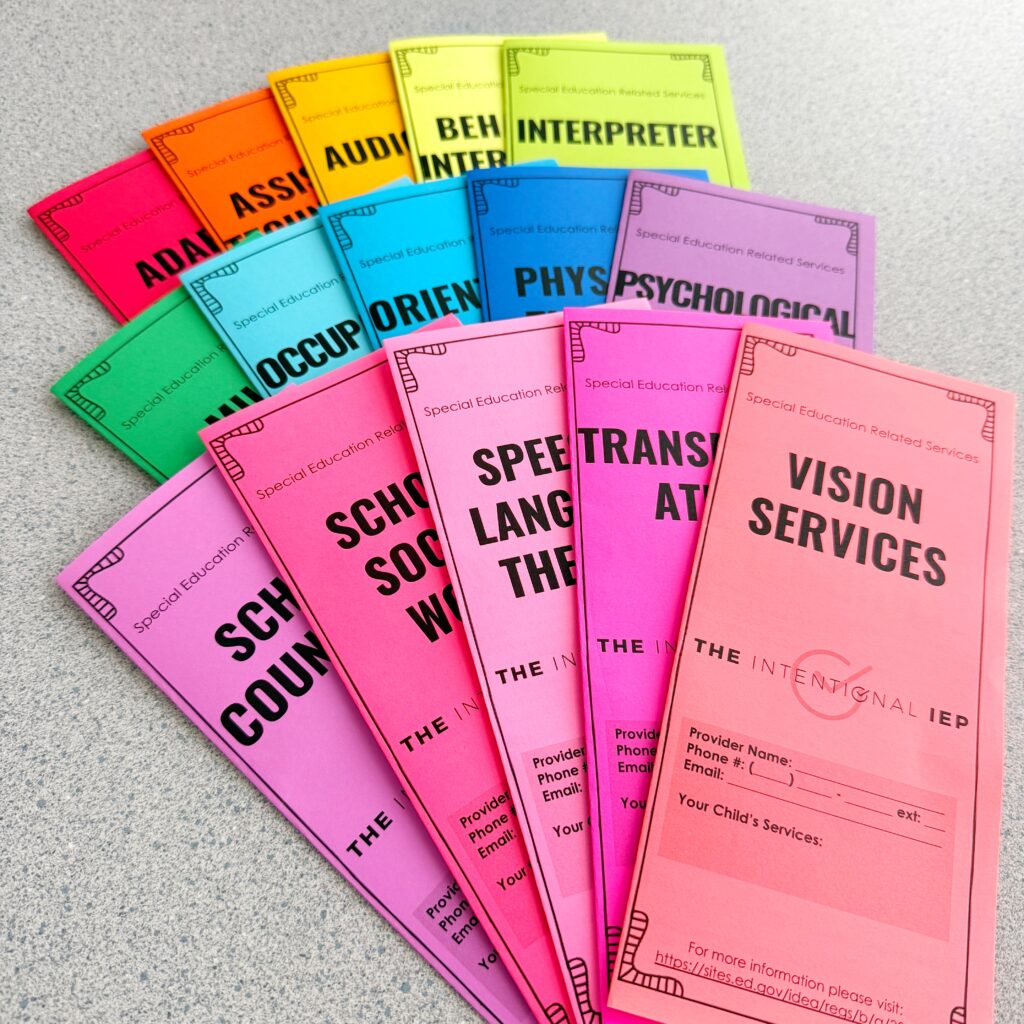
IDEA specifically identifies services including:
| Related service | What it may address in school |
|---|---|
| Speech-Language Pathology (SLP) | Speech production, receptive/expressive language, communication |
| Occupational therapy (OT) | Fine-motor and visual-motor skills, participation in school routines, access to classroom tasks, independence |
| Physical therapy (PT) | Mobility, positioning, movement, physical access and participation |
| Audiology | Hearing needs, auditory access and amplification |
| Interpreting | Access to communication for students who are deaf, hard of hearing, or deaf-blind |
| Counseling | Social-emotional, coping, behavioral, or school-related needs |
| Psychological services | Assessment, consultation, counseling, behavior-related planning |
| Orientation and Mobility (O+M) | Safe, independent navigation for students who are blind or visually impaired |
| School health/nursing | Health services required so the student can receive FAPE |
| Social work | School adjustment, counseling, family-school-community connections |
| Transportation | Specialized transportation required because of the student’s disability |
| Parent counseling/training | Helping parents understand their child’s needs and support IEP implementation |
| Recreation/therapeutic recreation | Leisure skills, participation and recreation needs |
| Medical services | Physician services for diagnostic or evaluation purposes |
IDEA’s complete definitions are found in 34 CFR §300.34, and it’s important to know that the list above isn’t necessarily exhaustive. I have had students with Music Therapy, and that’s because the U.S. Department of Education has explained that another developmental, corrective, or supportive service may be necessary and appropriate if and when the individual student requires it to benefit from special education and receive FAPE.
Related Services Aren’t Automatically Attached to a Disability
This is one of those places where IEP teams can unintentionally start working backward, and unfortunately we’ve all seen it happen.
We have a student with an Autism diagnosis and assume they need OT, or a student with a motor disability and assume the child needs PT. But the eligibility category doesn’t write the IEP for us.
Related service decisions should come from the student’s individual evaluation data, present levels, educational needs, and ability to participate in and benefit from their program.
Two students with the same eligibility can – and should – have completely different related services.
One student may need direct OT. Another may need OT consultation. Another may not require OT at all. That’s intentional IEP decision-making: student need first, service second.
Why Are Related Services Important?
Related services often address the thing standing between a student and meaningful access to instruction.
Think about the student who knows what they want to say but cannot effectively communicate it, or the student whose mobility needs make navigating the classroom difficult.
The special education teacher cannot – and should not – be expected to replace or do the work of the expertise of every IEP team member or school-related professional. Related service providers bring specialized knowledge to the IEP team, but their work shouldn’t be done in isolation either.
The strongest IEPs happen when we stop thinking: “Speech handles communication.” and start thinking: “How are we supporting this student’s communication across the entire school day?” That requires collaboration between providers, special educators, general educators, paraprofessionals, families, and the student when appropriate.
Where Are Related Services Listed in an IEP?
Look for a section labeled something like:
- Special Education and Related Services
- Services
- Related Services
- Services and Supports
- Program/Service Delivery
The exact layout and terminology can vary by state or IEP software; you and I both know there are way too many IEP templates out there.
Federally, however, the IEP must include a statement of the special education and related services the student will receive. It must also identify the projected beginning date and anticipated frequency, location, and duration of those services.
So you might see something similar to: “Occupational Therapy — 30 minutes, 1x/week, small-group therapy room, August 15–May 24.” in a table format. Don’t glance over or skim that table. As a case manager or classroom teacher, you need to know what service is happening, how often it’s happening, where it’s happening, and how it connects to the rest of the student’s program.
What Teachers Should Know About Related Services
The most important piece to remember is to not treat the related service pages as the providers’ part of the IEP. Those providers are part of the student’s IEP, and part of the student’s IEP team.
You need to know what your related service providers are targeting and what skills they’re working on. Ask what you can reinforce during instruction and share with them what you’re seeing between their sessions.
A student doesn’t only use fine motor skills during OT. Same goes for students don’t only communicate during speech, don’t only need emotional regulation during counseling. You get where we’re going with this, right?
The real payoff happens when the skills generalize into actual school life.
What Parents Should Know
Parents are equal members of the IEP team and should understand why a service is being recommended, what educational need it addresses, how it will be delivered, and what that delivery will actually look like once implemented.
Also, more services and more minutes isn’t automatically better. The goal is the right service, at the right level, for that individual student.
Related Services FAQ
Does every child with an IEP receive related services?
No. Related services are individualized. The IEP team determines whether a student requires them to benefit from special education.
Is speech therapy a related service?
Speech-language pathology is included in IDEA’s definition of related services. However, state standards can affect whether a particular service is treated as special education or a related service in certain circumstances.

Are OT and PT automatically provided for certain disabilities?
No. Services are determined from the student’s individual educational needs, not based solely on a diagnosis or eligibility category.
Can transportation be a related service?
Yes. IDEA specifically includes specialized transportation when required for the student to benefit from special education.
Are related services the same as accommodations?
No. IDEA separately requires the IEP to address related services, supplementary aids/services, program modifications, and appropriate assessment accommodations.
Can an IEP include a related service not specifically named by IDEA?
Potentially, yes. The Department of Education has explained that IDEA’s list is not exhaustive when another supportive service is required for the student to benefit from special education.
Related services in an IEP should never be a disconnected list of providers and minutes, or disconnected from the rest of the IEP. They are one part of an individualized plan built around what a student needs to access instruction, make progress, participate, and benefit from special education.
That’s why intentional IEP management starts long before we fill in a services table. We assess, we identify needs, we prioritize, we collaborate, then we build a plan in which the IEP goals, instruction, related services, supports, and progress monitoring actually work together.
That’s exactly the kind of full-process thinking we teach inside The Intentional IEP System, an educator-led IEP management system designed to help special education teachers know what to do, have what they need, and know what’s next.
An IEP doesn’t begin when you open the document—and the work doesn’t end when everyone leaves the meeting. There’s baseline data to gather, decisions to make, goals to connect, timelines to manage, services to implement, progress to monitor, and adjustments to make along the way. The Intentional IEP System gives special educators one connected way to manage all of it. Build a better system for the IEP work you’re already doing →