
If you’ve ever opened an IEP, landed on the supplementary aids and services section, and thought, Okay…but what exactly belongs here? – you’re not alone. This is one of those special education terms that sounds much more complicated than it needs to.
Supplementary aids and services are the supports a student with a disability needs to access, participate in, and make progress in school alongside students without disabilities to the maximum extent appropriate.
IDEA specifically defines them as aids, services, and other supports provided in general education classes, other educational settings, and extracurricular and nonacademic settings. This means these aren’t just “things we give the student during math.”
What Are Supplementary Aids and Services?
Think of supplementary aids and services as answering this question: What does this student need in order to meaningfully access and participate in their educational environment?
Depending on the student, that might include:
- visual schedules or written directions
- preferential or strategic seating
- adapted instructional materials
- assistive technology
- movement or sensory breaks
- peer supports
- behavior supports
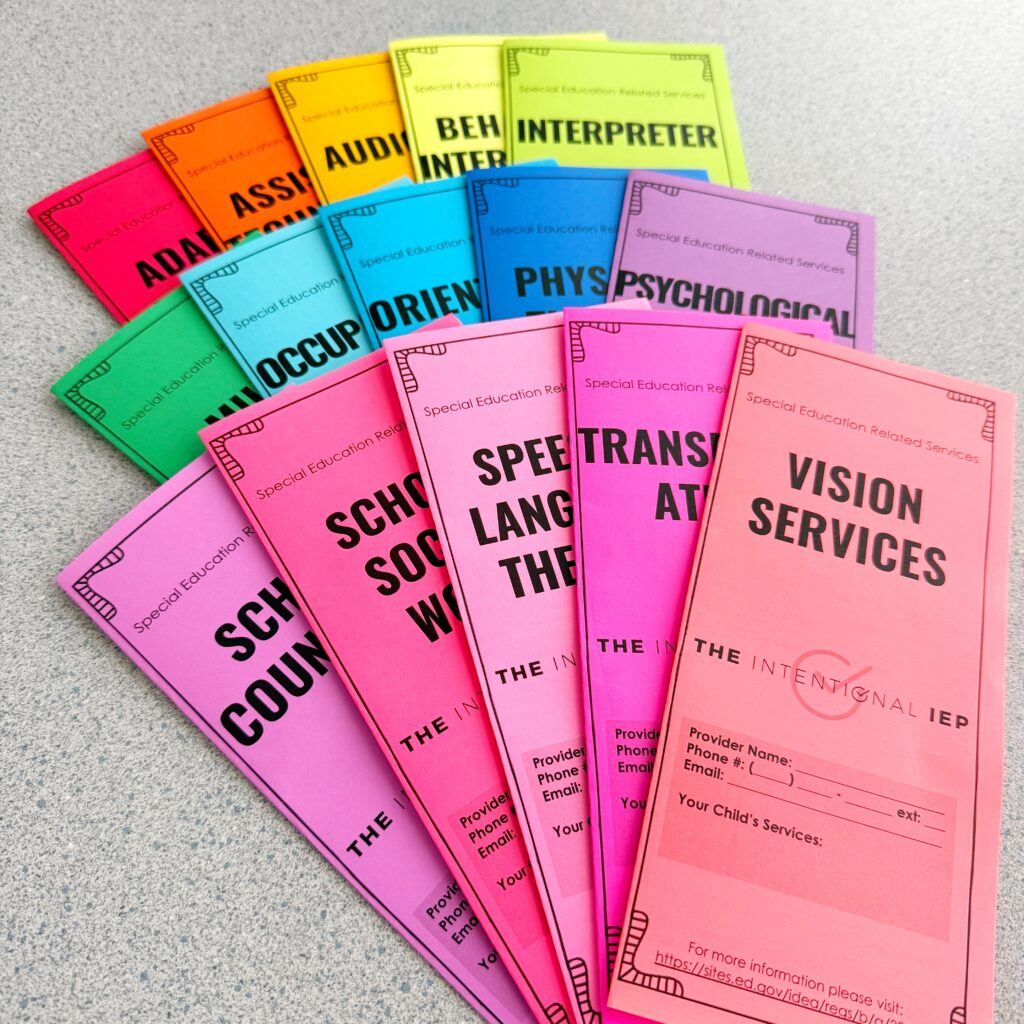
- a paraprofessional or other adult support
- communication supports
- accessible materials such as Braille or digital text
- consultation or training for the adults supporting the student
Federal guidance has specifically identified supports involving the environment, pacing, presentation, materials, assistive technology, behavior, adult assistance, and staff training as possible supplementary aids and services.
The IEP must also identify the anticipated frequency, location, and duration of services and modifications, and federal guidance emphasizes making the school’s commitment clear enough for parents and educators to understand.
So the next time you discuss supports, the IEP team needs to answer these questions: What barrier are we solving? When is this support needed? Who needs to understand it? And could another teacher implement it tomorrow without having been in this meeting?
Supplementary Aids Are Not Accommodations
One big misconception, or even a confusion, is that supplementary aids and accommodations are the same thing… even though they aren’t.
An accommodation changes how a student accesses learning without necessarily changing what the student is expected to learn. A modification may change the content or performance expectation.
Both can fall within the broader conversation about supplementary aids and services, depending on how a state’s IEP is structured. But supplementary aids and services can – and do – go much further.
Why Supplementary Aids and Services Matter for LRE
IDEA’s least restrictive environment requirements say that removal from the general educational environment should occur only when education in regular classes with supplementary aids and services cannot be achieved satisfactorily.
So before we jump from “this student is struggling in general education” to “this student needs a more restrictive placement,” the conversation has to include what supports could make participation successful.
That doesn’t mean every student belongs in general education 100% of the day. LRE is individualized. It means supplementary aids and services are part of that decision, not an afterthought once placement has already been decided.

What Do Supplementary Aids and Services Look Like in a Real IEP?
Here are three simplified examples.
Student 1: Early elementary reading
Need: Maya can participate in grade level literacy instruction, but has difficulty processing lengthy oral directions and independently organizing multi-step tasks.
Possible supports might include written/visual directions, tasks broken into smaller steps, additional processing time, and a visual checklist.
Notice that the team isn’t saying, “Maya needs help.” We’re defining what help actually looks like.
Student 2: Communication
Need: Eli uses AAC and needs access to his communication system throughout the school day.
His supplementary aids and services could include access to his AAC device across academic and nonacademic settings, aided language modeling, adapted materials, and training for staff who regularly interact with him.
IDEA guidance confirms that assistive technology can be documented as special education, a related service, or a supplementary aid or service depending on the child’s needs.
Student 3: Behavior and regulation
Need: Jordan has difficulty remaining regulated during lengthy whole-group instruction.
Supports might include scheduled movement opportunities, a visual schedule, explicit reinforcement strategies, access to a designated regulation space, and consultation with staff implementing behavioral supports.
Again, “frequent breaks” isn’t nearly as useful as knowing when, why, and how the support should happen.
Where Are Supplementary Aids and Services Found in the IEP?
IDEA requires an IEP to include a statement of the student’s special education, related services, supplementary aids and services, program modifications, and supports for school personnel, but unfortunately there isn’t one nationally standardized IEP form or template.
Depending on your state or district, or even the platform your district uses to write IEPs, you might find this section titled someting like: Supplementary Aids and Services, Accommodations/Modifications, Programs and Services, Classroom Supports, or a combined service grid.
And one important clarification: related services and supplementary aids and services are not the same thing, even if your IEP software displays them close together. Speech-language services, occupational therapy, physical therapy, counseling, or transportation may be related services. Supplementary aids and services are the additional supports that help the student access and participate.
Supplementary aids and services should not be treated like a checklist. This section of the IEP is part of the bigger picture for making the IEP work in real life.
Start with the student. Then identify the barrier and choose the support. Be specific enough that the people implementing the IEP know exactly what to do. Then progress monitor to determine whether it’s actually working.
That’s intentional IEP management: not writing supports because “we always put those in,” but connecting the information we know about the student to what happens next.
Writing the IEP is only one part of managing it. The Intentional IEP System helps special education teachers manage the work before, during, and after the meeting—from baselines and goals to timelines, implementation, progress monitoring, and everything in between. Instead of piecing together another resource every time something comes up, you’ll have one educator-led system designed to help you know what to do, have what you need, and know what’s next. See how The Intentional IEP System works →