
There is so much planning that goes in to an Individualized Education Program (IEP) for students with disabilities. There are many different things to think about when planning and writing an IEP to make sure it is the best possible plan for each student. After all, the I stands for Individualized.
We decided to come up with a fun list of ABC’s for IEPs.
A is for Advocacy
As the child’s biggest advocate, being a parent of a student with a disability can sometimes prove very overwhelming. Some parents choose to hire an advocate from an outside company to help them navigate the IEP process and special education laws in order to provide their child with the best possible education.
Here are 3 Ways to Help Parents Advocate for their Child.

B is for Behavior
Some students need data taken specifically on their behavior and the IEP team needs to discuss appropriate replacement behaviors. Sometimes the special education team needs to perform a Functional Behavior Assessment (FBA) on students and create a Positive Behavior Support Plan (PBSP) that is attached to their IEP.
C is for Changes in Current Functioning
This is a section on the IEP that explains where the student is currently performing in school on his/her current IEP goals and where data taken is listed. You can read more about it HERE. (The blog post I wrote last week on Basic Anatomy of an IEP)
D is for Disability
Every student on an IEP has a different type of disability that affects their learning in many different ways. Some examples of types of disabilities include: Autism Spectrum Disorder, Down Syndrome, Cerebral Palsy, Specific Learning Disability, Social Emotional Disability and Intellectual Disability. There are also many more types of disabilities that we did not list.
E is for Evaluation
Every student that is on an IEP has had an educational evaluation in order to qualify for Special Education. Some areas that the student may be evaluated in are: Cognition, Speech & Language, Fine Motor, Gross Motor, Adaptive Behavior, Social Emotional Behavior and Academics.
F is for FAPE
FAPE stands for Free and Appropriate Public Education and EVERY child has the right to one, including students with disabilities.
G is for General Education
Time spent in general education is always a big topic during an IEP meeting. As students get older, the curriculum gets more difficult and the student’s disability can greatly impact how much they may or may not be able to participate in the general education setting.
H is for Highly Qualified Teacher
A highly qualified teacher is a teacher who meets the requirements set out in No Child Left Behind and IDEA.
I is for IDEA
IDEA stands for Individuals with Disabilities Education Improvement Act (IDEIA), which is Public Law 108-446 (generally referred to as the Individuals with Disabilities Education Act. IDEA is the Federal special education law that provides a free appropriate public education in the least restrictive environment to all eligible children with disabilities.


J is for Jargon
It is no secret that the world of Special Education has many different abbreviations and words that can be overwhelming for staff to learn let alone parents and caregivers. Special Ed Jargon Everyone Should Know can be a helpful resource for staff, parents and caregivers of students with disabilities.
K is for Kids
Sometimes we get temporarily lost in the jargon, acronyms and multiple disabilities, and we must remember that the student that we are discussing in the meeting is still just a kid. Our goals should be measurable, functional and age appropriate for kids.
L is for Least Restrictive Environment
Least Restrictive Environment, or LRE, is the amount of time that a student spends in a general education classroom. Students who have general education LREs spend most or all of their day in a general education classroom with their same-aged peers. Students with more severe disabilities that cannot be accommodated in general education classrooms may be pulled out frequently or placed in a special classroom.
M is for Modifications & Accommodations
Modifications and accommodations are two words that are frequently tossed around in the world of special education, and sometimes used interchangeably.
N is for New IEP Goals
Each year a new IEP is written for each student in special education. The special education team will meet and discuss the student’s current functioning on their current IEP goals, and in turn, write new IEP goals for the student to master in the areas of special education that the student receives services in over the next year.

O is for Observation
It is a Special Educator’s job to be watching and recording systematic information on their student-facts, data, behavior, time on task, etc. in a structured or unstructured observation.
P is for Paraprofessional
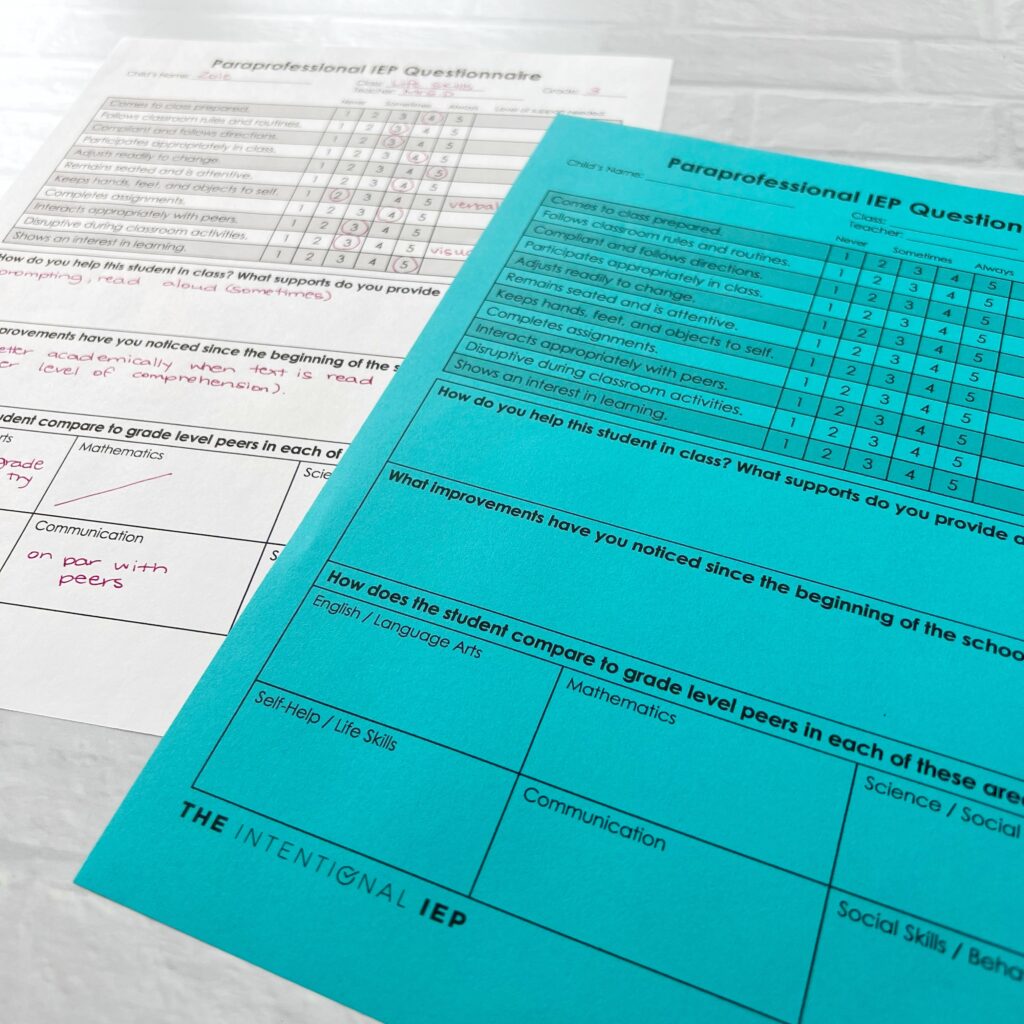
A paraprofessional is an individual who provides direct support to a child, teacher, or other school professional and who works only under the direct supervision of qualified personnel.
Q is for Qualified Examiner
A Qualified examiner is a person licensed or certified in the state in which the evaluation is performed, who performs a formal diagnostic assessment in the area of disability in which the person is qualified to perform the assessment.
R is for Related Services
Related services are special education services given in addition to classroom instruction to address different issues that may interfere with a student’s learning. Some examples of different types of related services are speech therapy, occupational therapy, physical therapy and counseling.


S is for Service Time
Service time refers to how much time the student spends receiving specially designed instruction.
T is for Transition Plan
If you are teaching pre-teens and teens, you will become very familiar with IEP Transition Plans.The Individuals with Disabilities Act (IDEA) tells us that once a student turns sixteen years old, they must have a transition plan written into their IEP.
U is for Universal Design
Universal design is a concept or philosophy for designing and delivering products and services that are usable by people with the widest possible range of functional capabilities. This might include accessing products using assistive technology.
V is for Very Organized
When writing an IEP, it is best to be very organized. You should keep the student’s data all in one organized manner, have work samples and have data and information from the student’s general education teacher and related service providers to enter into the IEP.
W is for Weaknesses
IEP meetings can be hard because, although student strengths are discussed, much of the meeting can tend to focus on the child’s weaknesses and how the team can put a plan in place to help them succeed. This information can be difficult and overwhelming for parents and guardians to discuss. It is also important to remember to Keep the IEP Strengths Focused on the student when writing it.
X- Xtra Time
When writing an Individualized Education Program (IEP), it is best to give yourself plenty of time and planning to write it with much consideration for the student. Try not to wait until the night before the meeting and rush the work. Check the IEP over for correct punctuation, grammar, data and dates and send a copy home to the family before the meeting so that they have time to look it over.
Y is for “Yes We Can Do That.”
“Yes we can do that” is a great phrase when discussing a student’s needs with his/her special education team at an IEP meeting. Parents want to feel that the professionals working with their child will do anything possible to help their child be successful.
Z is for Zoom Meeting
Zoom is a free app for schools that allow you to hold virtual IEP meetings and many schools have been holding more virtual meetings since the pandemic. Besides this, virtual IEP meetings can sometimes be easier for working parents or even stay-at-home parents who do not have a babysitter for their little ones when they need to attend their child’s IEP meeting.

For any virtual IEP meeting, you’ll want to make sure you have a solid way to get e-signatures on the documents.
We hope that the list above helps you to identify and better understand the many words and jargon are used when being a part of Individualized Education Plans. IEPs work best when the entire team understands the language and process in order to help the student be the most successful.
Writing the IEP is only one part of managing it. The Intentional IEP System helps special education teachers manage the work before, during, and after the meeting—from baselines and goals to timelines, implementation, progress monitoring, and everything in between. Instead of piecing together another resource every time something comes up, you’ll have one educator-led system designed to help you know what to do, have what you need, and know what’s next. See how The Intentional IEP System works →