
Data collection is one of those things that sounds straightforward on paper.
Teach the skill. Give the student an opportunity to demonstrate it. Record the result. Repeat.
Then you walk into an actual special education classroom.
One student needs help transitioning. Another is refusing work. Someone needs the bathroom. A para has a question. You’re trying to run a small group while keeping an eye on the rest of the room, and somewhere in the middle of all of that, you’re supposed to remember to make a tally mark on a data sheet.
So, how do you actually fit in data collection when your classroom is busy, unpredictable, and sometimes downright chaotic?
The answer usually isn’t finding more time. It’s creating a data collection system that works within the time you already have.
Stop Trying to Collect Everything Every Day
One of the easiest ways to make data collection feel impossible is believing that every goal for every student needs a new data point every single day.
Before creating your system, look at each student’s IEP and determine what data you actually need to collect and how frequently you need to collect it.
Then create a rotation.
You might monitor certain students or goals on Mondays and Wednesdays and others on Tuesdays and Thursdays. You might collect academic goal data one week and focus more heavily on another set of goals the following week.
The goal is not to collect the greatest possible quantity of data.
The goal is to collect enough meaningful, accurate data to determine whether the student is making progress and whether instruction needs to change.
Build Data Collection Into Your Classroom Rotations
Instead of treating data collection as something extra that needs to happen after instruction, make it part of instruction.
Centers and classroom rotations can work especially well for this.
While students rotate through independent work, sensory activities, task boxes, fine motor activities, or other familiar tasks, one station can be dedicated to working individually or in a small group with a teacher or paraprofessional.
That becomes your data station.
You don’t necessarily need a 30-minute assessment session with each student, either. Sometimes a few focused minutes provides the opportunities you need to collect a useful data point.
When these opportunities are built into the schedule, data collection stops competing with instruction because it becomes part of instruction.
Consider Having a Dedicated Data Day
Another option is to designate a certain day—or part of a day—for more intentional progress monitoring.
For example, Friday might include familiar independent activities, preferred tasks, centers, sensory activities, or other things students can successfully complete while adults rotate students through quick goal checks.
This doesn’t mean that Friday is the only day you pay attention to progress. You’ll still collect natural data throughout the week.
It simply creates a predictable opportunity to fill in areas where you need more information.
If an entire data day doesn’t work for your classroom, try a recurring data block instead. Even 20 or 30 minutes scheduled consistently can make a difference.
Keep Your Data Collection Tools Within Reach
Your beautifully organized data binder isn’t especially helpful if it’s sitting across the classroom when you need it.
The easier your system is to access, the more likely you are to use it.
Try keeping data sheets on clipboards near the areas where you’ll actually collect the data. Individual student folders can also work well because the student’s goals and corresponding forms stay together.
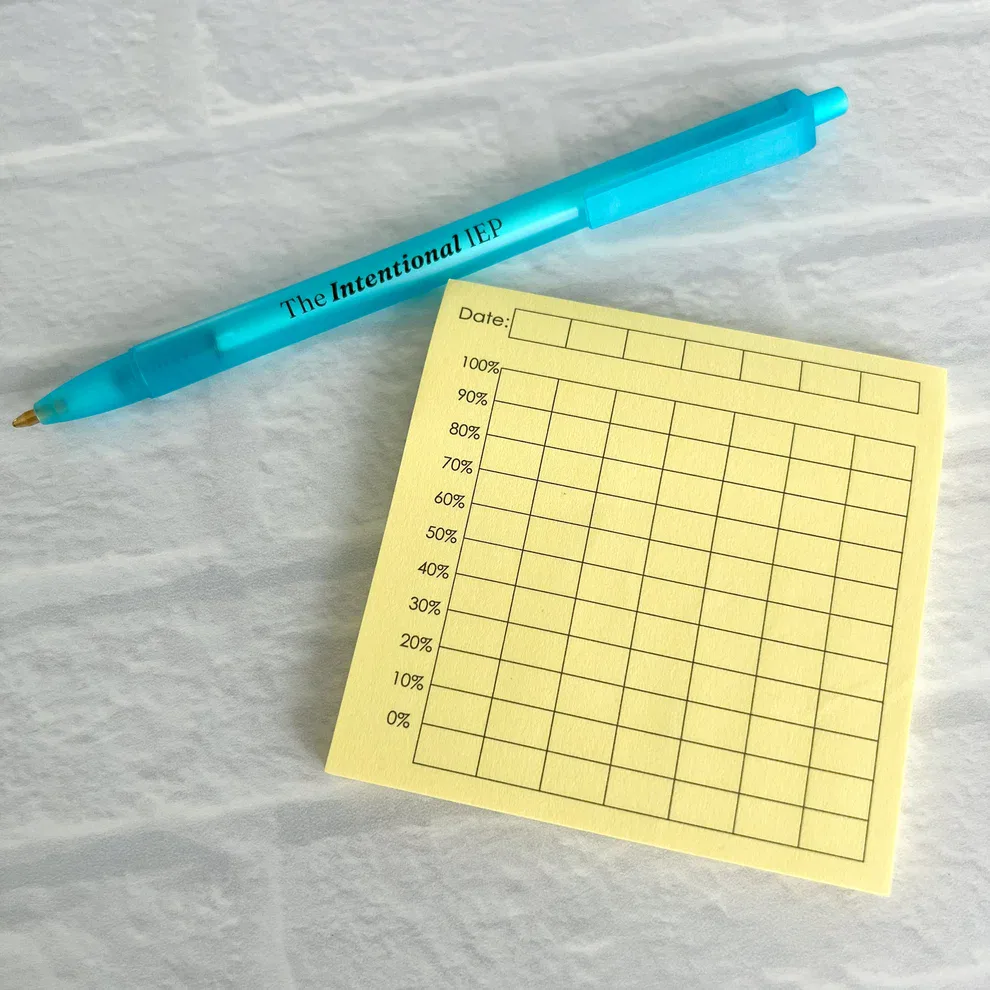
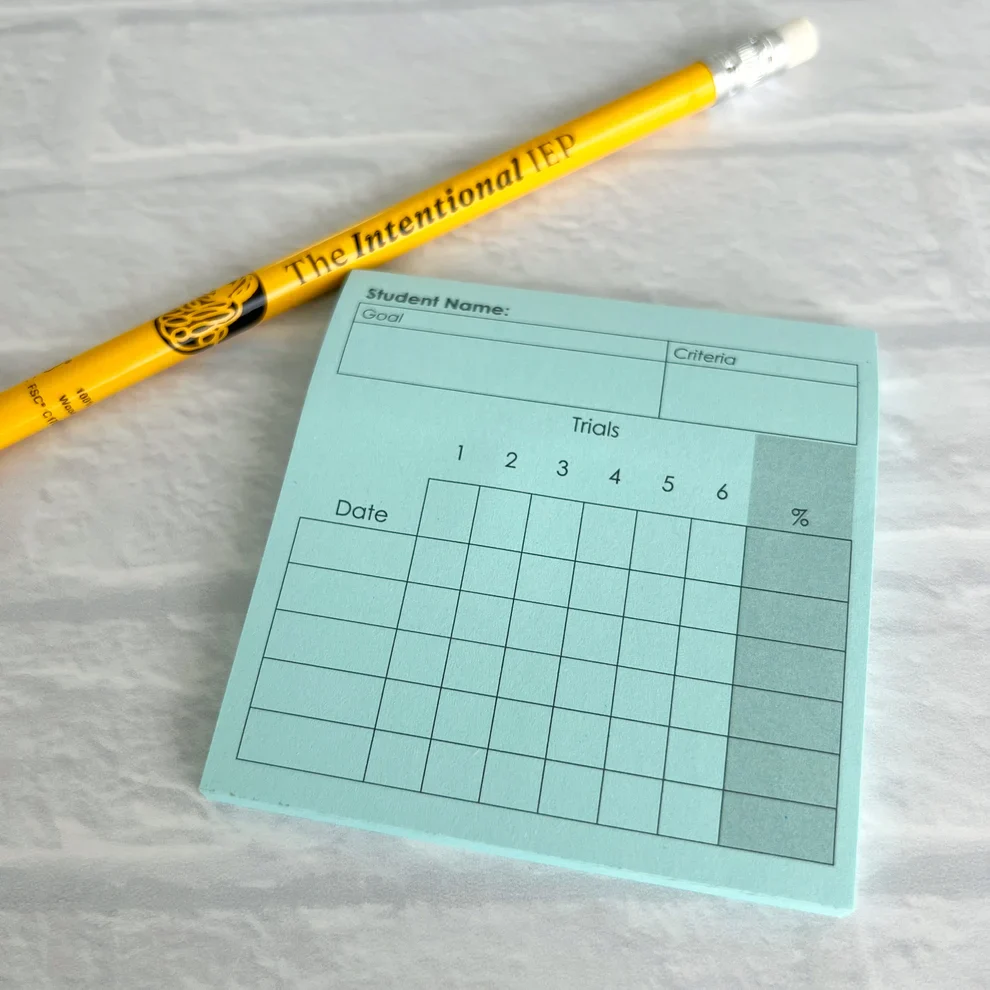
For extremely quick data, sticky notes can be surprisingly effective. Make a tally mark or jot down a few words in the moment and transfer the information to the student’s permanent data record later.
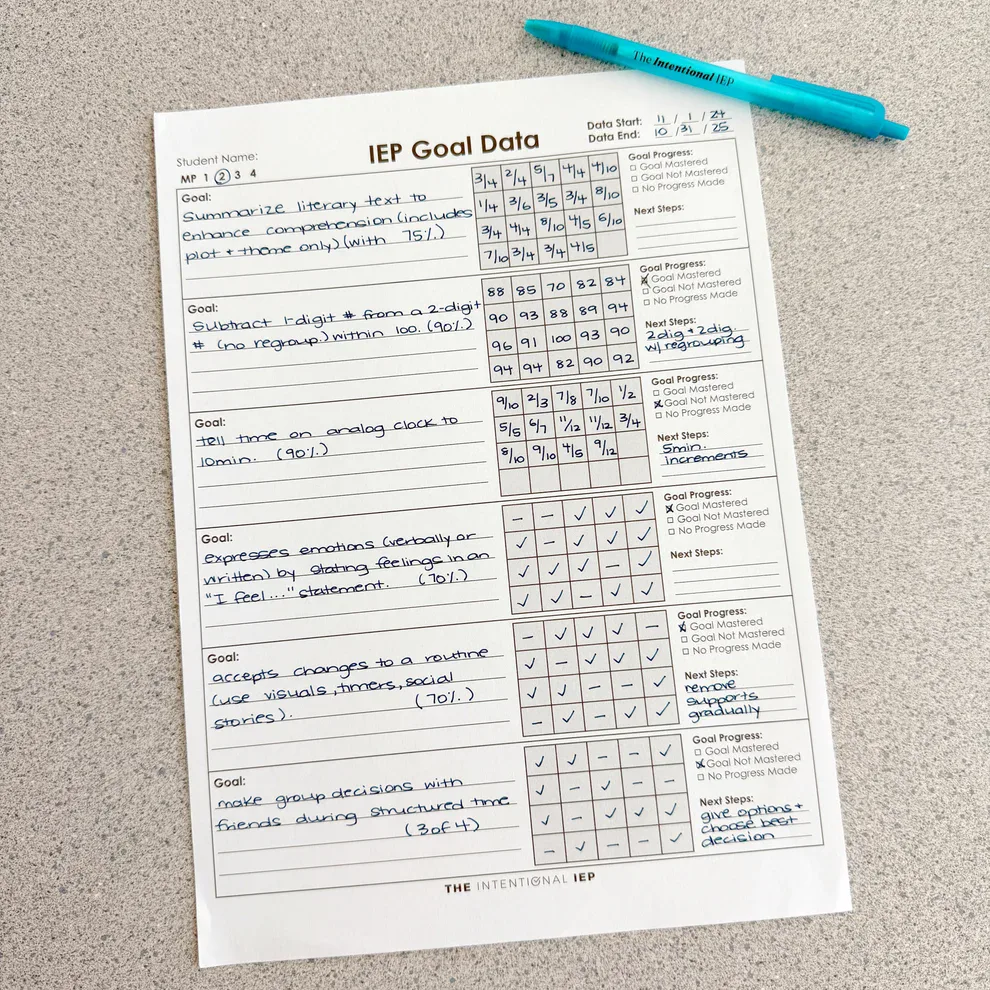
These IEP Goal Progress Sticky Notes, IEP Goal Monitoring Data Notepads, and IEP Goal Data Data Notepads are designed for this exact kind of quick classroom documentation.
The best tool isn’t necessarily the most elaborate one. It’s the one you’ll actually have in your hand when you need it.
Simplify Your Data Forms
If taking a single data point requires you to write a paragraph, your system probably isn’t going to survive a busy school day.
Look for ways to simplify.
Depending on the goal, you may be able to use:
- Tally marks
- Yes/no checkboxes
- +/- recording
- Trial-by-trial data
- Frequency counts
- Prompt levels
- Duration
- Short anecdotal notes
You can always add additional context when it’s necessary.
For example, if you’re tracking how independently a student performs a skill, quickly marking the level of prompting required may tell you far more than writing several sentences after every attempt.
The simpler the recording process is, the easier it becomes to collect data consistently.
Use Your Paraprofessionals
Data collection does not always have to fall entirely on the special education teacher.
When appropriate, paraprofessionals can help collect data during instruction, centers, transitions, and other parts of the day.
The key is making sure everyone understands exactly what they’re measuring.
Instead of saying, “Take data on his behavior,” define the behavior and explain what counts and what doesn’t.
Instead of, “See how she does with this goal,” make sure the staff member understands the skill, the expected response, the prompting procedures, and how to record the outcome.
You can even assign certain staff members to specific students or stations during rotations so everyone knows where their attention should be focused.
Consistency matters. Two adults observing the same student should be measuring the same thing in the same way.
Collect Data During Natural Opportunities
Not every data point needs to come from a formal assessment.
A lot happens during an ordinary school day.
If a student has a communication goal, there may be opportunities to observe that skill during centers, lunch, recess, arrival, or play.
Social skills can often be observed during interactions with peers.
Following-directions goals can be monitored during classroom routines.
Functional skills can be measured while students are actually performing those skills.
When you know your students’ goals well, you can begin spotting these opportunities throughout the day.
Keep a quick recording system nearby so that when the opportunity happens, you can capture it.
Don’t Forget That Behavior Is Data, Too
Here’s an important one: sometimes you planned to collect academic data and couldn’t.
That can still tell you something.
If a student refuses the task, requires significant prompting, is unable to regulate enough to participate, or engages in behaviors that prevent instruction from occurring, don’t automatically treat that period as if nothing happened.
Document what occurred when it is relevant to the student’s goals and programming.
If the same thing repeatedly interferes with a student’s ability to work on a particular skill, that’s important information for the IEP team.
The data isn’t always, “Student answered 8 out of 10 questions correctly.”
Sometimes the information you need is about why the student couldn’t access those 10 questions in the first place.
Get the Classroom Regulated First
There will also be days when meaningful academic data collection simply isn’t the first priority.
If the classroom is dysregulated or there is a safety concern, address that first.
Work on routines. Use visuals. Build in movement and sensory breaks when appropriate. Reduce distractions. Create predictable rotations. Teach students what to expect.
As routines become more established, you’ll often find that there are more opportunities for focused instruction and data collection.
Trying to force a one-on-one progress monitoring session in the middle of significant classroom disruption may not give you particularly useful information anyway.
Stabilize what you can, then collect the data.
Create a Two-Step System
One of the most practical ways to handle data in a busy classroom is to separate capturing the data from organizing the data.
During instruction, capture only what you need:
A tally.
A checkbox.
A number.
A prompt level.
A few words.
Then designate a regular time to transfer or review that information.
Maybe that’s during planning time, at the end of the school day, or once a week when you update progress monitoring records.
This keeps you from trying to simultaneously teach, manage behavior, supervise the classroom, AND beautifully document every observation.
Capture now. Organize later.
Find the System That Works in Your Classroom
There is no single perfect data collection system for every special education classroom.
Some teachers love binders.
Some want a clipboard for each student.
Others need sticky notes within arm’s reach.
Some prefer digital forms they can access from a phone or tablet.
And you may need a combination of all of them.
What matters is that your system is simple, accessible, consistent, and realistic enough to use during an actual school day.
Data collection shouldn’t require a perfectly quiet classroom or an extra hour that magically appears in your schedule.
Build it into rotations. Spread it throughout the week. Let your support staff help. Capture quick information when you can. Use natural opportunities. And remember that sometimes the unexpected things happening in your classroom are giving you valuable information, too.
You don’t need a perfect data collection system.
You need one that actually gets used.
Writing the IEP is only one part of managing it. The Intentional IEP System helps special education teachers manage the work before, during, and after the meeting—from baselines and goals to timelines, implementation, progress monitoring, and everything in between. Instead of piecing together another resource every time something comes up, you’ll have one educator-led system designed to help you know what to do, have what you need, and know what’s next. See how The Intentional IEP System works →