
Transitioning from one activity to another can be challenging for some students. Supporting them in a way that makes sense begins with including the goal in their IEP.
The examples below are a great place to start to make sure that your students can effectively transition to new activities and classes with minimal assistance.
Why Is Writing Transition IEP Goals Beneficial For Students?
Transitioning between tasks is a functional life skill because it directly impacts a student’s ability to function successfully in school, daily routines, and eventually in the workplace. Struggling with transitions can lead to frustration, anxiety, task avoidance, or behavioral challenges, making it crucial to teach and support these skills in the IEP.
Transition IEP Goals That Work
The important thing to remember when writing transitioning goals is that not all children are the same. While that should go without saying, there can be a tendency to group students struggling with transitions into pre-determined categories defined by their behavior.
It is important to understand the reasons behind the struggle and make sure that those issues are supported so that the student can learn to successfully transition.
The goal examples below are really designed for PreK and early elementary students, but they can be adjusted for older students as well.
Transition Goal Example 1:
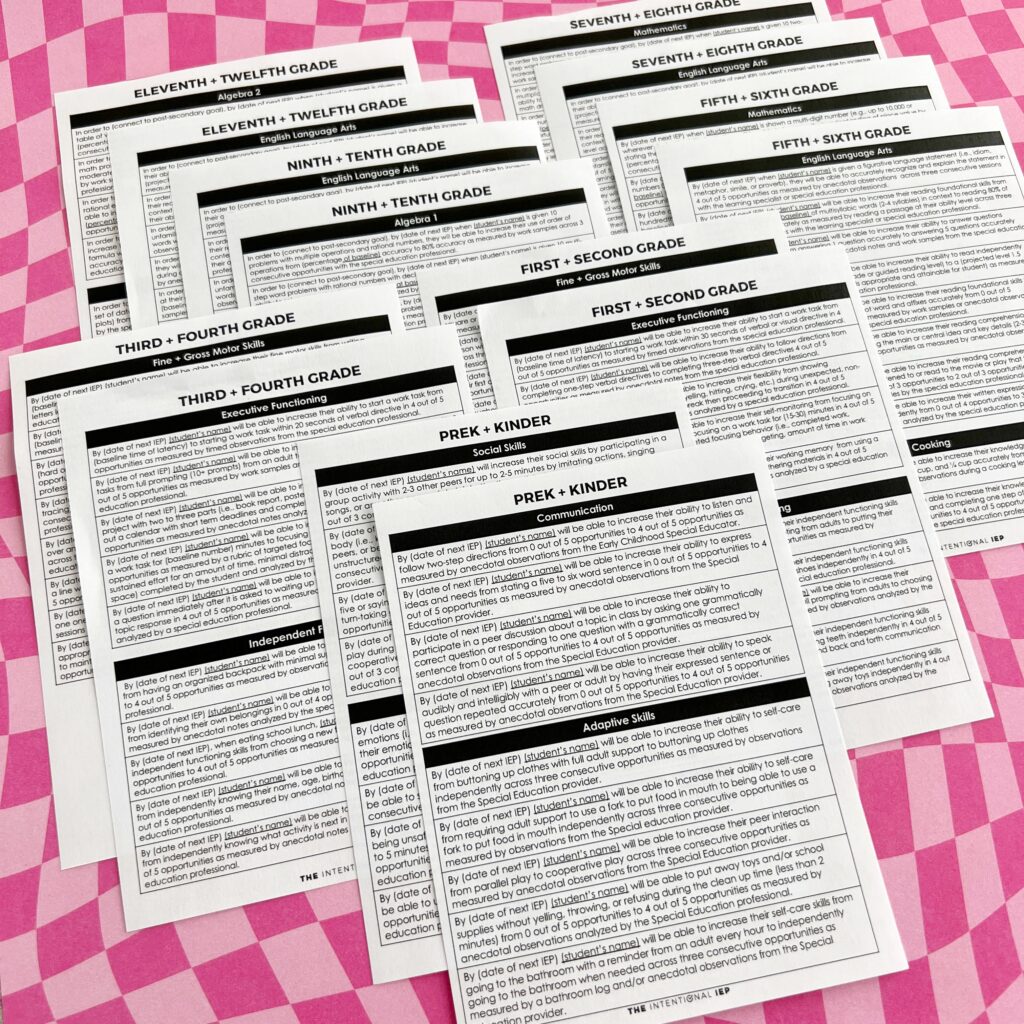
“By (date) student will transition from one activity to the next with the absence of behaviors that are inappropriate and disruptive, including (list the behaviors here), within # seconds of the SD with % accuracy for # consecutive trials.”
Why We Like This Goal: There are a few reasons why we like this transition goal. First, it has the time frame listed immediately so that there is a clear date as to when the goal will be fully achieved. We also like that the specific behaviors that the child is displaying that are inappropriate and disruptive are explicitly laid out. This makes it easy for any special ed or inclusion teacher to quickly pinpoint those behaviors and make sure that they’re being addressed. It takes the subjectiveness out of the situation and makes it very matter-of-fact. And finally, we like that there is a specific time limit for when the student will comply. This also takes the ambiguity out of the goal and makes it very clear, measurable, and recordable.

Transition Goal Example 2:
“By (date) across the school campus, when the student is presented with an unexpected change to his schedule, (ex: fire drills, assemblies, last minute change in schedules), the student will use self-calming strategies to remain calm as seen by (staying in his area until directed to move, transitioning with a quiet mouth and keeping his hands to himself) without displaying interfering behaviors (ex: crying, running away, yelling) in X of X opportunities over a #-week period as measured by data collection.”
Why We Like This Goal: As with the first goal example, the second goal is also a SMART goal. It provides explicit examples of the appropriate behaviors, as well as the interfering behaviors. There is a clear time frame for when the goal will be measured and how many times the student must master it within that time frame. It is also an easy goal to explain to students because they understand what “keeping his hands to himself” and “running away” or “yelling” means. Making sure that the student understands what is expected of him is vital to the success of the goal.
Remember…
IEP goals should be S.M.A.R.T. and should be individualized to meet the student’s needs. IEP goals and objectives written for transitioning between tasks should target reducing resistance to transitions, increasing independence, and using strategies to move between activities smoothly.
You can further support students with their transition goals through accommodations and modifications, the use of visual schedules and checklists, timers and countdown cues, transition cues, and social stories.
Your district’s IEP platform gives you a place to document the IEP. The Intentional IEP System was built for the work happening around it. Created by a veteran special educator, the system brings together practical workflows, professional guidance, screeners, goals, data tools, planning support, and more to help you confidently manage the IEP process without handing your professional judgment over to software. Explore the educator-led IEP management system →