
The difference between accommodations and modifications may have been drilled into your head as a special education teacher, but it is safe to assume that the rest of the IEP team may not be as familiar with the difference between the two.
Before diving in to the IEP meeting, make sure that you take the time to explain to all present the difference between modifications and accommodations.
The Difference Between Accommodations and Modifications
Once the IEP understand the difference between accommodations and modifications, they are much better equipped to make decisions about a student’s IEP.
Understanding Accommodations
An accommodation changes HOW the student learns the material.
As special education teachers, we know that it’s so important that when we are choosing accommodations for a student, that we are individualizing them.
But that doesn’t mean, for example, that 4 or 5 of your students can’t have the same exact accommodation. This is where adding in teacher training and supports to the child’s IEP is key.
Why?
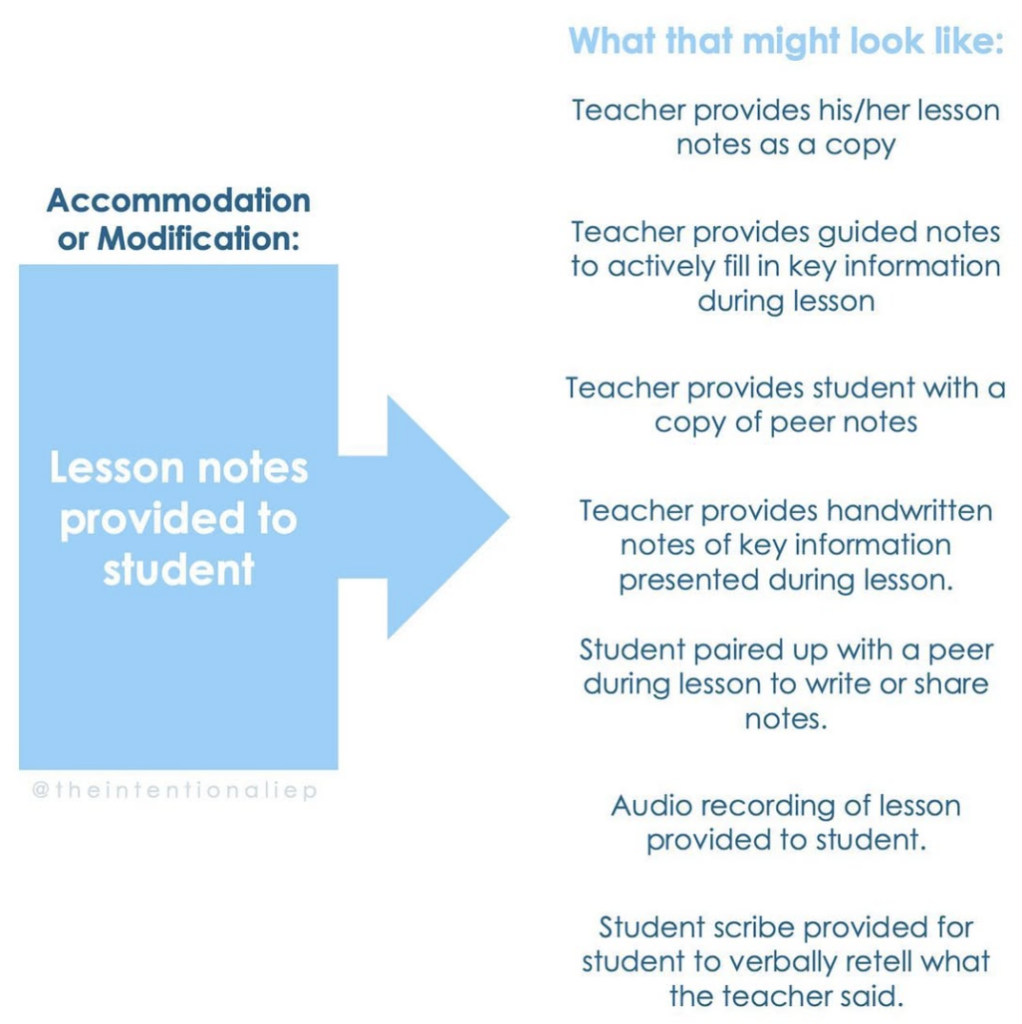
Because if we write “Lesson notes provided to the student.” and hand off the IEP to the rest of the IEP Team, it can be translated in many different ways… as shown in the graphic above.
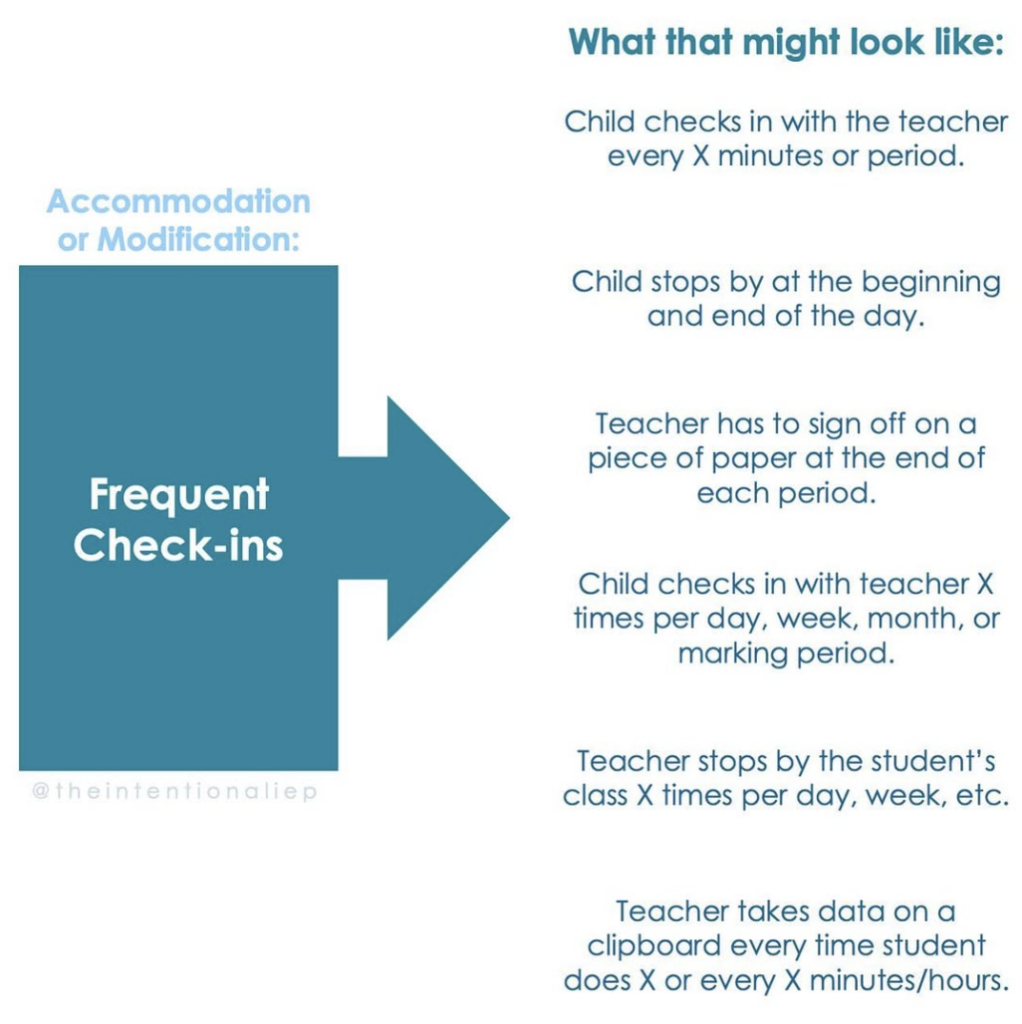
If we write “Frequent check-ins.”, it can also be translated in many different ways… as shown in the graphic above.

Another example could be if we write “Reminders to stay on task.” This can also be interpreted a wide number of ways as demonstrated above.
It’s important that when our students work with other adults and professionals, those adults and professionals know what each accommodation means and looks like for that specific student.
For Stephanie, this accommodation might look like the teacher providing a copy of the lesson notes. But for Jaxon, this accommodation might look like an audio recording of the lesson is being provided. And maybe for Zoie, the teacher is providing guided notes for Zoie to fill in during the lesson.
Teacher trainings and supports written into the IEP don’t have to take up hours of time on anyone’s end either. This conversation may take 5 or 10 minutes and then everyone is on the same team, everyone knows what this accommodation looks like for this specific student and how to provide it.
Understanding Modifications
A modification changes what the student is taught or expected to learn and how he or she is graded. It’s a fundamental alteration of the material.
Modifications use a different grading rubric because students are tested or assessed on different material.
Modifying the format of a test or activity is also a modification.
If the reading level has to be modified that is a modification and not an accommodation.
Changing the student expectations and reducing the complexity of an activity are also modifications.
Simply put, accommodations change how the student learns and modifications change what they learn. By taking the time to explain the difference to the IEP team, you’re creating a well-informed panel of educators and parents who can proactively address a student’s needs.
An IEP doesn’t begin when you open the document—and the work doesn’t end when everyone leaves the meeting. There’s baseline data to gather, decisions to make, goals to connect, timelines to manage, services to implement, progress to monitor, and adjustments to make along the way. The Intentional IEP System gives special educators one connected way to manage all of it. Build a better system for the IEP work you’re already doing →