
While not specific to special education, the four functions of behavior are often discussed and used as the basis for intervention strategies.
But what are they, why are they so important to understand, and how can they help shape your intervention in the special ed classroom? Let’s look at those questions further.
Defining the Four Functions of Behavior
Every behavior that a child exhibits is based on a specific need or want at that moment. While there are millions of different behaviors, the functions of those behaviors fall into four specific categories.
The four functions of behavior are:
- Sensory Stimulation
- Escape Environment or Task
- Attention Seeking
- Tangible Items
When you understand the motivation for the child’s behavior it gives you insight into what they need. That insight helps drive the intervention strategy that is used to help meet the child’s needs and redirect the behavior to something healthier and more productive.

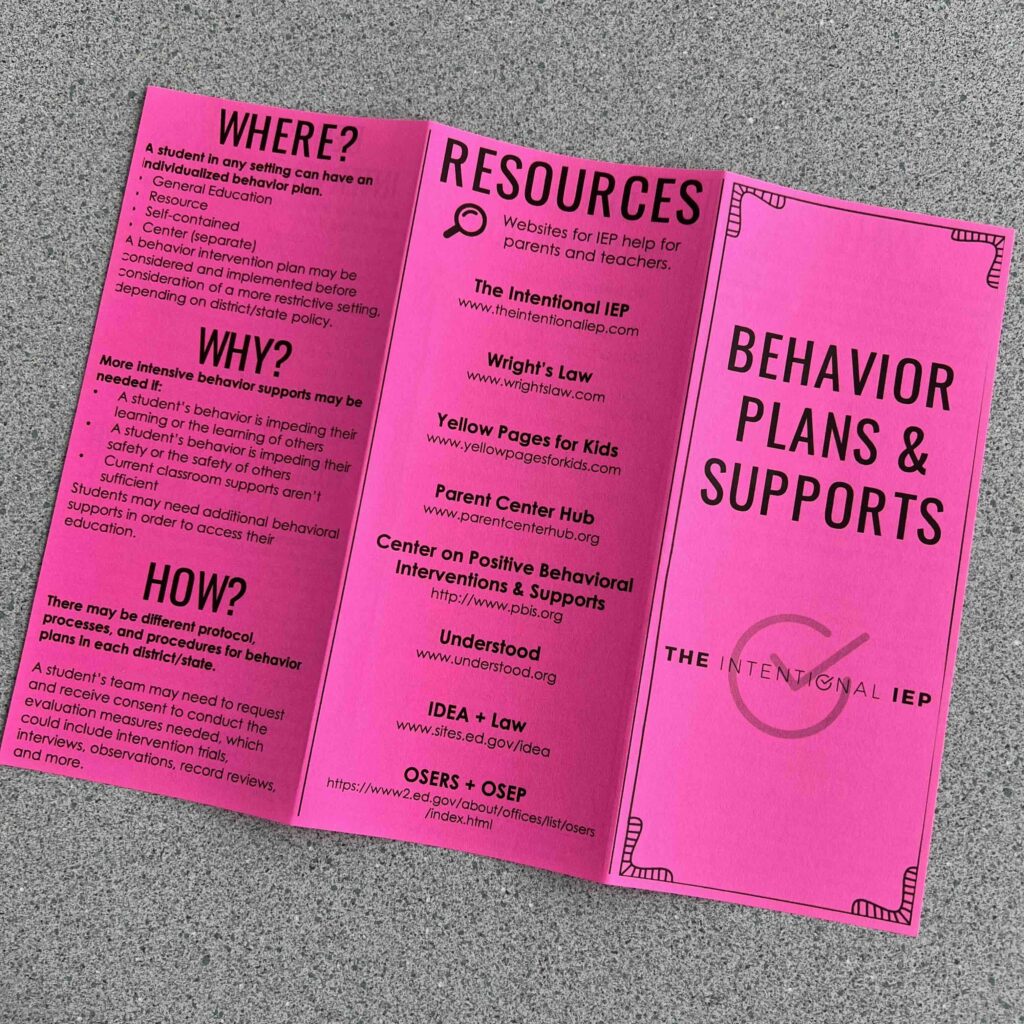
Functions of Behavior and Intervention Strategies
Each function of behavior presents differently and indicates the child’s needs. While not all-inclusive, the examples below demonstrate some of the common behaviors associated with each function and some of the intervention strategies that can be used to address those needs.
Sensory Stimulation
Children who are seeking sensory stimulation are often seen exhibiting behaviors that are pleasurable for them. For example, they may be seen twirling their hair around their fingers, humming, or picking at their nails or skin. While not everyone may find these activities pleasurable, for the student, they are soothing and provide pleasure in the moment.
Examples of Interventions for Sensory Stimulation
- Offer sensory-based experiences in the classroom through the use of sensory bins or a sensory wall.
- Offer musical reinforcement for students who need auditory stimulation.
- Provide tactile stimulation through the use of mini-trampolines or rocking chairs.
Escape from Environment or Task
For those children who are trying to escape from an environment or task, their behavior is usually easy to classify. They can be found hiding, running away, avoiding people and situations, or avoiding discomfort.
Examples of Interventions for Escape Behavior
- Lessen the difficulty of assignments or tasks.
- Provide frequent breaks.
- Include the child’s likes or interests in the assignment or task.
- Modify how the assignment can be completed (example – change the assignment to tablet-based instead of paper and pencil).
- Create and stick to a schedule to provide predictability.
- Offer choice.
- Ignore the behavior and continue with the assignment or task as planned.

Attention-Seeking
Not all attention-seeking behavior is negative, but there are times when it is used in an inappropriate manner. Those are the times when children are most likely to cause disruptions in class through their behavior. Some examples of behavior that may need intervention include: being excessively loud, whining, waving arms to get attention, and more.
Examples of Interventions for Attention-Seeking Behavior
- Provide 1:1 student-teacher interaction with the help of support staff.
- Increase proximity to the child by moving closer to him.
- Rearrange seating so he is closer to the teacher/front of the classroom.
- Provide more frequent positive interactions.
Tangible Items
Students who want a particular item or to participate in an activity may display inappropriate behavior to get what they want. These tangible items or activities are things that they find pleasurable and not being able to have them or participate in them can lead to disruptive behavior. However, not all behavior is negative when it comes to obtaining those tangible items (i.e. – purchasing an item that one desires). Examples of negative behavior might be throwing a tantrum to get an object or stealing an object from a person or store.
Examples of Interventions for Attention-Seeking Behavior
- Allow the child access to highly desired items.
- Provide preferred activities between activities that are highly preferred and highly non-preferred.
Understanding the four functions of behavior, how they might be displayed by students, and interventions to try can make managing your special ed classroom much easier.
Remember, be proactive in your behavioral approaches and don’t forget to use appropriate behavioral assessments to get accurate data.
If every upcoming IEP sends you searching for the next goal, form, data sheet, training, or reminder, the problem probably isn’t that you need more resources. You need a better way to manage the process. The Intentional IEP System connects the tools, guidance, and workflows special educators need across the IEP lifecycle so you can stop managing IEPs one meeting at a time and start working more intentionally. See what intentional IEP management looks like →