
When a student’s behavior begins interfering with learning, safety, or relationships, it’s natural to want quick solutions.
But real, lasting change starts with understanding why the behavior is happening.
A Functional Behavior Assessment (FBA) is the structured process schools use to identify the function of challenging behavior so that interventions actually address the root cause — not just the symptoms.
If you’re wondering what the full process looks like, here’s a clear, step-by-step breakdown of how an FBA is completed from start to finish.
Step 1: Obtain Parental Consent
Before an FBA can begin, parental consent must be obtained.
If the student is already receiving special education services, this typically starts the official evaluation timeline (often 30 school days, depending on district guidelines).
At this stage, it can also be helpful to begin routing parent interview forms so that information gathering can happen efficiently.
Team members involved may include:
- Case manager
- Social worker
- School psychologist
This step formally initiates the process.
Step 2: Conduct Teacher and Staff Interviews (Days 1–5)
Early in the process, interviews are conducted with staff who work directly with the student. This often includes:
- General education teacher
- Special education teacher
- Specials teachers
- Paraprofessionals
Common tools used during this step may include:
- Teacher questionnaires
- Motivational assessment scales
- Staff interview forms
The goal is to gather insight about patterns, triggers, strengths, and previous strategies that have been attempted.
These interviews provide context before formal data collection begins.
Step 3: Clearly Define the Challenging Behavior (Days 6–10)
Before collecting data, the team must agree on a clear, observable definition of the behavior.
For example:
Instead of:
“Disruptive behavior”
Define:
“Leaves seat without permission during independent work for longer than 30 seconds.”
Instead of:
“Defiant”
Define:
“Refuses adult direction by verbally saying ‘no’ and putting head down for more than two minutes.”
Team members involved in defining behavior may include:
- General education teacher
- Special education teacher
- Paraprofessional
- Administration
- Itinerant staff
A clear definition ensures everyone is measuring the same behavior consistently.
Step 4: Complete Student and Parent Interviews (Days 1–10)
Understanding behavior requires hearing from the student and family whenever possible.
Parent interviews help identify:
- Behavior patterns at home
- Triggers or stressors
- Motivators
- Medical or sleep concerns
- Family perspective
Student interviews (when appropriate) can provide insight into:
- What feels hard
- What feels frustrating
- What helps
- What they need
These interviews are often completed by:
- General education teacher
- Special education teacher
- Social worker
- School psychologist
Family input is essential to forming an accurate picture, because what is seen at school is only part of the equation.
Step 5: Collect ABC Data (Days 10–20)
This is one of the most important steps.
The team collects ABC data over 5–10 days across multiple settings and times of day.
ABC stands for:
- A – Antecedent: What happened right before the behavior?
- B – Behavior: What exactly did the student do?
- C – Consequence: What happened immediately after?
To make data collection more manageable:
- Create data sheets with checkboxes or circles to save time
- Do not collect data all day — select specific time blocks
- Rotate time periods (for example: 9:00–9:30 one day, 12:00–12:45 the next)
- Use multiple staff members to help collect data
Involving general education teachers, paraprofessionals, special education teachers, and other staff increases accuracy and prevents burnout.
The goal is to identify consistent patterns.
Step 6: Enter Data into the FBA Data Tool (Days 15–25)
The district team meets to compile and enter ABC data into a structured FBA data system.
This step often includes:
- Graphing patterns
- Identifying trends
- Comparing behaviors across settings
- Reviewing frequency and intensity
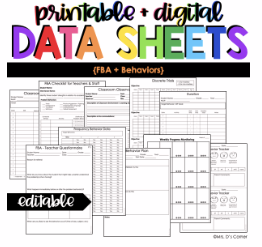
This transforms raw data into meaningful insights. Your district should already have an FBA Data Tool that they would like you to use. If they do not, try these.
Step 7: Develop a Hypothesis Statement (Days 15–25)
Using the analyzed data, the team creates a hypothesis statement.
A hypothesis statement answers:
- Under what conditions does the behavior occur?
- What is the student trying to gain or avoid?
For example:
“When presented with independent writing tasks lasting longer than 10 minutes, the student puts their head down to avoid difficult academic work.”
The hypothesis connects the behavior to its likely function.
Common behavior functions include:
- Escape/avoidance
- Attention
- Access to preferred items
- Sensory regulation
This step is critical — because interventions must match the function.
Step 8: Complete a Competing Pathways Chart
The team then connects the hypothesis to intervention planning using a Competing Pathways Chart.
This tool helps identify:
- The challenging behavior
- The function of the behavior
- A replacement behavior
- Prevention strategies
- Teaching strategies
- Reinforcement strategies
This step ensures the plan isn’t just reactive and includes proactive skill-building.
Step 9: Develop or Amend the Behavior Intervention Plan (BIP) (Days 15–28)
Using the hypothesis and pathways chart, the team creates a Behavior Intervention Plan (BIP).
The BIP outlines:
- Target behaviors
- Prevention strategies
- Replacement skills to teach
- Reinforcement systems
- Staff responses to behavior
- Data collection methods
If the student receives special education services, the IEP may need to be amended to include the BIP.
At this stage, it’s also important to:
- Establish follow-up data collection procedures
- Schedule a future review meeting
Step 10: Monitor Progress with Ongoing Data Collection
Once the BIP is implemented, teams collect:
- Frequency data
- Duration data
- Intensity data
This step determines whether the interventions are working.
Without monitoring, the team cannot know if changes are needed.
Step 11: Review and Update After 4–6 Weeks
After 4–6 weeks, the team reconvenes to:
- Review progress data
- Determine effectiveness
- Adjust interventions if necessary
- Update the BIP
Behavior change takes time, and ongoing adjustments ensure the plan remains effective.
Improving Student Outcomes
An FBA is not just paperwork. It is a systematic, collaborative process designed to understand a student’s needs and respond with targeted, supportive interventions.
When done thoroughly, an FBA:
- Reduces reactive discipline
- Improves student outcomes
- Supports staff consistency
- Strengthens collaboration with families
Most importantly, it shifts the question from: “How do we stop this behavior?” to: “What is this student trying to communicate — and how can we help?”
That shift changes everything.

No one teaches us how to advocate—they just tell us to do it. But real advocacy requires real knowledge. The Intentional IEP gives you that: clear goals, training that actually makes sense, and tools that save you time. Because when you know better, you advocate better.