
Ask almost any special education teacher what takes up the most time during the school year, and IEP writing will likely be near the top of the list.
It’s not just writing the IEP itself. It’s collecting input, reviewing data, writing present levels, drafting goals, communicating with families, coordinating schedules, and making sure every required section is complete before the meeting even begins.
The good news? Experienced special educators have learned that a few simple systems can dramatically reduce the amount of time spent writing IEPs—without sacrificing quality.
Here are some of the best time-saving IEP writing tips and strategies veteran teachers rely on year after year.
1. Start Earlier Than You Think You Need To
One of the most common pieces of advice from experienced teachers is surprisingly simple:
Start early.
Instead of waiting until the week before an annual review, begin working on pieces of the IEP several weeks—or even months—in advance.
As new assessment data becomes available, update present levels.
When progress monitoring suggests a student has mastered a goal, begin thinking about the next instructional target.
Rather than writing an entire IEP in one sitting, break it into smaller tasks throughout the month. This makes the workload much more manageable and greatly reduces the stress that often comes with looming deadlines.
2. Contact Families Before the Meeting
Many veteran teachers schedule a quick phone call or send an email to families before the IEP meeting.
These conversations allow you to:
- Review proposed goals.
- Discuss parent concerns.
- Answer questions ahead of time.
- Gather important input.
- Identify potential disagreements before the meeting.
By the time everyone sits down together, much of the discussion has already happened. Meetings often move more efficiently because families have had time to process information and prepare their thoughts.
3. Collect Teacher and Service Provider Input Early
Don’t wait until the day before the meeting to ask for updates.
Create a system for collecting input several weeks in advance.
Some teachers use:
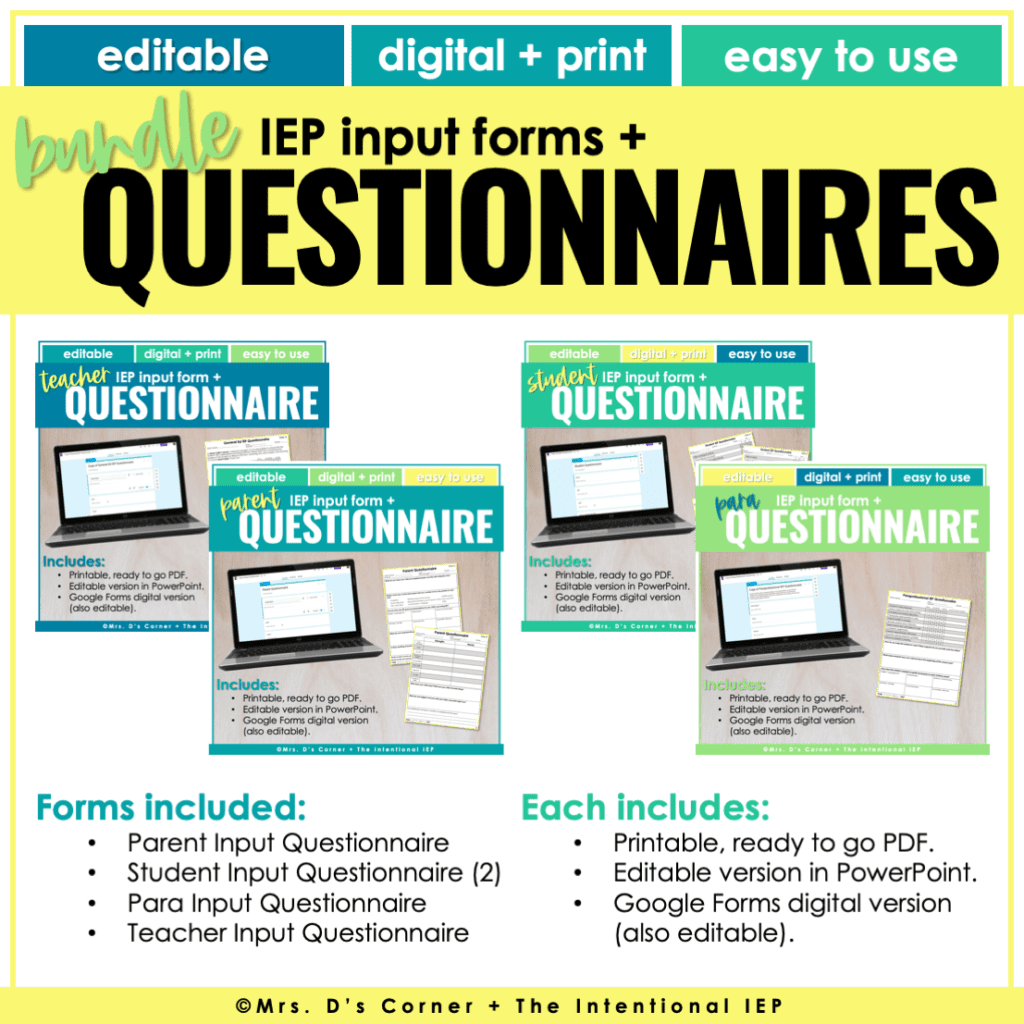
- Digital forms
- Shared documents
- Teacher questionnaires
- Service provider checklists
- Student transition surveys
Having everything in one place makes it much easier to write present levels and document current performance.
It also reduces the last-minute scramble of tracking people down for information.
4. Draft in Word or Google Docs First
One of the most popular time-saving strategies has nothing to do with IEP software.
Many experienced teachers write their entire IEP in Microsoft Word or Google Docs before transferring it into their district’s program.
Why?
Because word processors offer:
- Better formatting
- Spell check
- Larger writing space
- Easier editing
- Automatic saving
- Less worry about losing work if the software crashes
Once everything is finalized, it’s simply a matter of copying and pasting into the district’s IEP system.
5. Create Your Own IEP Planning Template
Many teachers keep a planning document that includes every section they’ll need during the meeting.
This might include:
- Present levels
- Goal ideas
- Assessment data
- Parent concerns
- Teacher notes
- Accommodation updates
- Transition information
- Meeting notes
Having one working document keeps everything organized and serves as a roadmap throughout the meeting.
6. Use AI Thoughtfully
Artificial intelligence has become another helpful tool for many educators.
For example, AI can help:
- Organize parent questionnaire responses.
- Summarize teacher input.
- Draft narrative language.
- Improve sentence flow.
- Rewrite repetitive wording.
- Proofread sections for clarity.
It’s important to remember that AI should support your professional judgment—not replace it.
Always review, edit, and verify any AI-generated content before including it in an IEP, and be sure to follow your district’s policies regarding student information and confidentiality.
7. Review the Previous IEP Carefully
There’s no reason to reinvent the wheel every year.
Before writing a new IEP, carefully review the previous one.
Pay particular attention to:
- Accommodations
- Modifications
- Service minutes
- Successful supports
- Parent concerns
- Previous goals
Many teachers even highlight sections they know will change, making it easier to update information without accidentally deleting something important.
8. Send a Draft Before the Meeting
Some teachers find that sending a draft to team members before the meeting saves significant time.
When appropriate and consistent with district procedures, providing a working draft gives families and staff the opportunity to:
- Review proposed goals.
- Prepare questions.
- Suggest edits.
- Think through recommendations.
This often leads to more productive meetings because participants arrive informed and ready to collaborate.
9. Create Reusable Goal Banks
Writing every goal from scratch can be incredibly time-consuming.
Instead, build your own library of high-quality goal examples.
Organize them by skill area, such as:
- Reading comprehension
- Decoding
- Written expression
- Math computation
- Functional skills
- Executive functioning
- Social skills
- Communication
These shouldn’t be copied word-for-word for every student. Instead, think of them as starting points that you can individualize based on each student’s unique needs.
Over time, your personal goal bank becomes one of your greatest time-saving tools.
10. Work on One Section at a Time
Looking at an entire blank IEP can feel overwhelming.
Instead of trying to complete everything in one sitting, focus on one section at a time.
For example:
Monday: Present Levels
Tuesday: Goals
Wednesday: Accommodations
Thursday: Transition
Friday: Final review
Breaking the process into smaller pieces often makes it feel much more manageable.
11. Create Checklists for Yourself
Experienced teachers rarely rely on memory alone.
Many use simple checklists to ensure every required component has been completed before the meeting.
A checklist might include:
- Parent input received
- Teacher input collected
- Service provider updates
- Progress monitoring reviewed
- Draft goals completed
- Procedural safeguards prepared
- Meeting notice sent
- Documents ready to print or share
A five-minute checklist can prevent hours of corrections later.
The Beauty of Systems
Veteran special education teachers aren’t necessarily writing faster because they’ve memorized every section of the IEP.
They’re faster because they’ve built systems.
They’ve created routines for gathering information, communicating with families, organizing documents, and preparing meetings long before deadlines arrive.
The best time-saving tip isn’t a secret shortcut.
It’s creating consistent habits that reduce decision fatigue and eliminate last-minute scrambling.
Try implementing just one or two of these strategies this year. As your systems become routine, you’ll likely find yourself spending less time stressing over paperwork—and more time focusing on what matters most: supporting your students.
Your district’s IEP platform gives you a place to document the IEP. The Intentional IEP System was built for the work happening around it. Created by a veteran special educator, the system brings together practical workflows, professional guidance, screeners, goals, data tools, planning support, and more to help you confidently manage the IEP process without handing your professional judgment over to software. Explore the educator-led IEP management system →