
There are so many different ways to adapt and modify a lesson or activity to make it appropriate for your students.
As teachers, we often fall into a rut where we find our favorite adaptations and stick with them. It is fine to have favorites, but it is also important to look at the big picture and explore different adaptations when the go-to ones are not really working.
Check out this list of nine different types of adaptations (different than accommodations and modifications) that can be used to make any activity or lesson more accessible for students.
Adaptations for Lessons and Activities
Not all adaptations work for all students. Be open to trying new or different ones to address the needs of the students in your class or on your caseload. You may be surprised by what works best and discover new ways to reach learners.
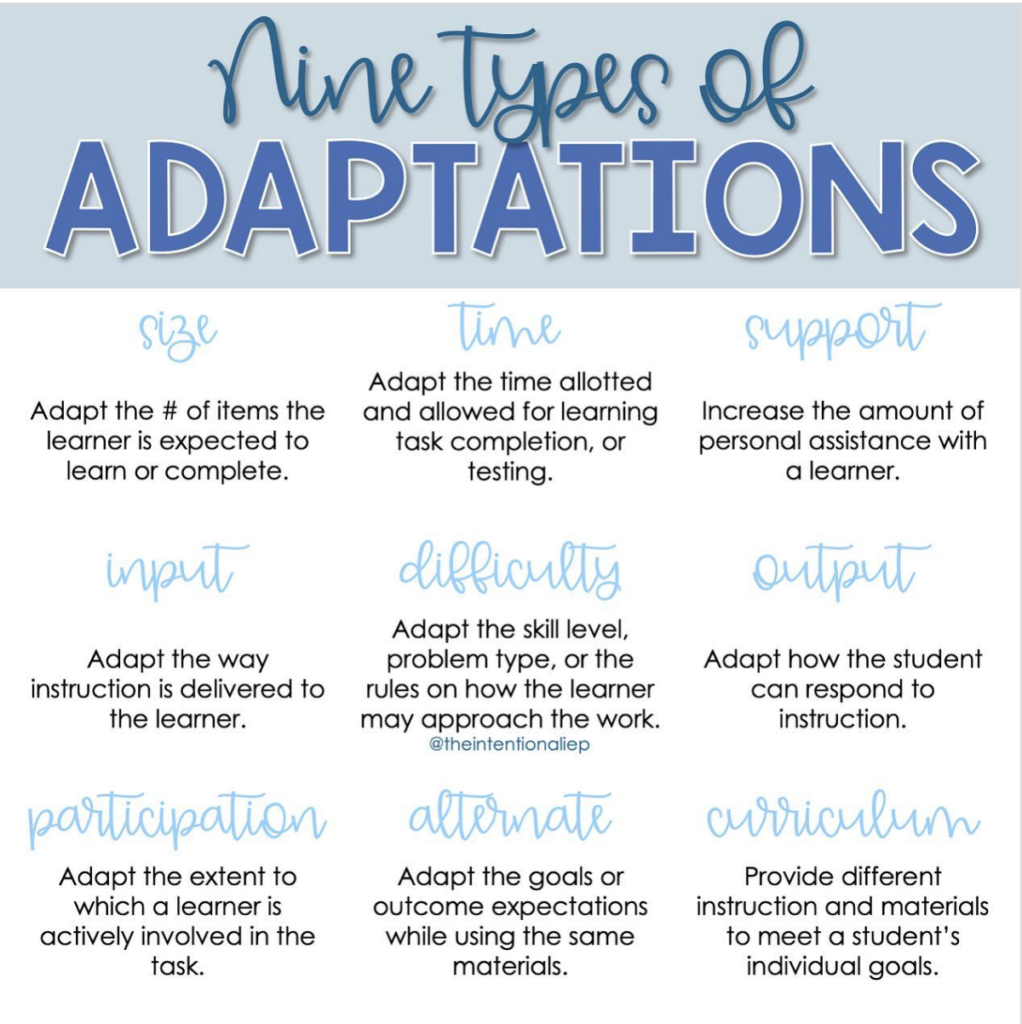
1 – Size of Assignments
Adapt the number of items that the student is expected to learn or complete. This ensures that they have the same grade-level material – just less of it.
2 – Time
Adapt the amount of time a student has to complete an assignment or assessment. Extended time can be time and a half, double-time, or tailored to meet your student’s individual needs. If time is adjusted, encourage the learner to use all of the time that he has been given. Going slowly, checking, and double-checking work may not be something he has had time for in the past and may not know how to do.
3 – Support
Sometimes students just need a little bit more support. Adapt a lesson or activity by increasing the amount of personal support the student receives to complete the assignment.
4 – Input
Students all learn differently and adapting the way information is delivered to a student can greatly improve their understanding and retention of the material. For example, using audiobooks for students with reading difficulties is an easy way to deliver the same information in a different format.
5 – Difficulty
By adapting the skill level, problem type, or the rules on how the learner may approach the work, you make the activity more accessible.
6 – Output
Adapt how the student can demonstrate or present the information that he has learned. For instance, a student with dysgraphia may do better demonstrating his understanding of a subject when doing an oral presentation versus writing a paper.
7 – Participation
Adapt the extent to which a learner is actively involved in the task or activity. Some students may need less participation to be successful while others may need more.
8 – Alternate
Using the same materials, adapt the goals or outcome expectations to meet the student’s needs and ability level.

9 – Curriculum
Adapting the curriculum means providing entirely different instruction and materials to meet a student’s individual goals.
There is never only one way to adapt activities to meet a student’s needs. Remember that the ultimate goal is for the student to learn and demonstrate his understanding of the material. How that happens and what adaptations are needed to make that happen are up to you.
Don’t forget that you also have accommodations and modifications to help students with their learning and skill mastery!
Your district’s IEP platform gives you a place to document the IEP. The Intentional IEP System was built for the work happening around it. Created by a veteran special educator, the system brings together practical workflows, professional guidance, screeners, goals, data tools, planning support, and more to help you confidently manage the IEP process without handing your professional judgment over to software. Explore the educator-led IEP management system →