
Do you have students who would benefit from participating in Extended School Year (ESY) services?
Learn what type of data to collect to ensure that your students get the support that they need!
What is ESY?
Unlike summer school, Extended School Year, or ESY, is summer instruction that is designed to meet children’s individual needs.
For students who have speech therapy services that may mean seeing the speech therapist over the course of the summer months.
For students with dyslexia, ESY might entail a continuation of their reading remediation services.
Not all students with IEPs qualify for ESY services, so it’s important that if you think your student would benefit from it, appropriate data is collected to support the services.
Data to Document and Collect for ESY
Memory Retention Issues
If your student has trouble remembering concepts or information over a short period of time, document that. While remembering over the weekend may be a struggle for them, without ESY services they may struggle immensely when they return over a break that is months long.
A good place to start can be examining how well they do after winter break and how much they retained. While this is not extra data that you’re collecting, it can be useful in proving that the student will benefit from ESY services.
Behavior Struggles
For students with behavioral needs that may impede learning, ESY can make a big difference. Oftentimes, by the time the behavior is under control in the classroom, a significant amount of time has already passed. ESY helps close that gap for some students; for some ESY lets students catch up and for others it provides instruction to maintain their skill levels. It can also provide continuity and make the transition back to school easier and more successful.
You can demonstrate a need for services by documenting behavior changes after holiday breaks, long weekends, and extended absences. Any change in behavior that is a regression to a previously modified behavior should be noted.
Lost Ground on Any IEP Goals
Any change in academic progress toward an IEP goal after a break should be documented. This applies to all areas of an IEP, not just behavior or memory retention issues.
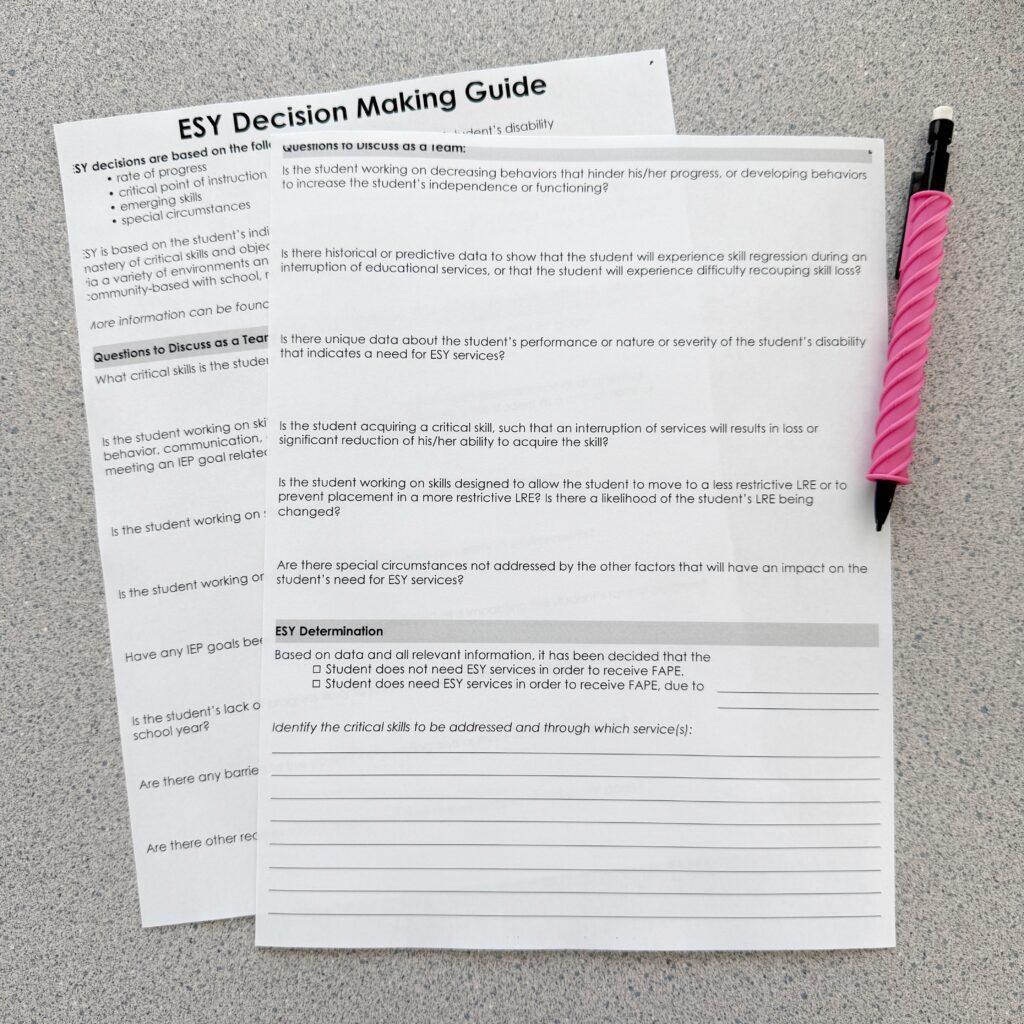
If a child returns from winter break and is unable to perform at the same level that he or she was before the break, document the regression. This demonstrates that after an absence of direct instruction, the child struggles and that continued instruction is vital to their success.
Before any extended breaks, collect data on how the student is performing and when you return after break, collect more data to see if regression occurred. The data will show how significant the child’s regression may or may not be.
It is also important to document the amount of time it takes for the student to catch back up to where they were before they left for the break.
Recoupment Timeframes
One of the most important areas to document is recoupment time because many ESY determinations hinge on how long it takes a student to recoup lost skills after a break. This refers to the amount of time it takes a student to regain skills after a break in instruction.
For example, if a student returns from winter break and it takes several weeks to reach the same level of performance they had prior to the break, that lag should be carefully recorded.
In general, if it takes more than six to eight weeks to recoup lost skills after a two- or three-week break, that is often considered significant and may indicate the need for ESY services to prevent that regression in the first place.
Slow or Inconsistent Growth (Rate of Progress)
Another important data point is the student’s overall rate of progress. Some students may not exhibit clear regression, but their progress throughout the year is minimal, inconsistent, or plateaued – even with targeted supports and specially designed instruction.
If the instructional team observes that progress is slow and fragile, long breaks can easily stall or reverse what has been gained. Comparing student growth during periods of consistent instruction versus after extended breaks can help strengthen the argument for ESY as a way to maintain that fragile momentum.
A student doesn’t have to regress to qualify, but they may qualify because their progress is so slow that long breaks could halt it altogether. So if progress monitoring shows plateaued or minimal growth over time, especially with intensive supports, this is worth documenting.
Emerging Skills
Emerging skills are another key consideration. When a student is just beginning to independently demonstrate a new skill – for example: recognizing sight words with minimal prompting or initiating a request without adult assistance – those gains can be fragile.
Without consistent opportunities to practice and reinforce them, these skills may not only plateau but disappear altogether. ESY can help solidify those emerging skills so students don’t have to relearn them when they return in the fall.
Documenting how close a student is to meeting a goal, along with how consistent their performance is across settings and staff, can show that additional summer instruction is necessary to protect that progress.
So, if a student is on the verge of mastering a skill, ESY may be needed to solidify it and prevent backsliding.

Is It Additional Work to Collect Data for ESY Services?
Contrary to what many new special education teachers believe, collecting data for ESY services is not additional documentation. Instead, it is looking at the documentation that would have regularly been done on a student’s progress/regression after an extended break.
Most ESY programs specifically look for a lack of retention as the main qualified for ESY goals. However, if a student is making significant progress toward a goal, ESY services may be recommended to continue that progress. While that does not require additional work or documentation, it does require the teacher to be aware of each student’s level of progress throughout the school year.
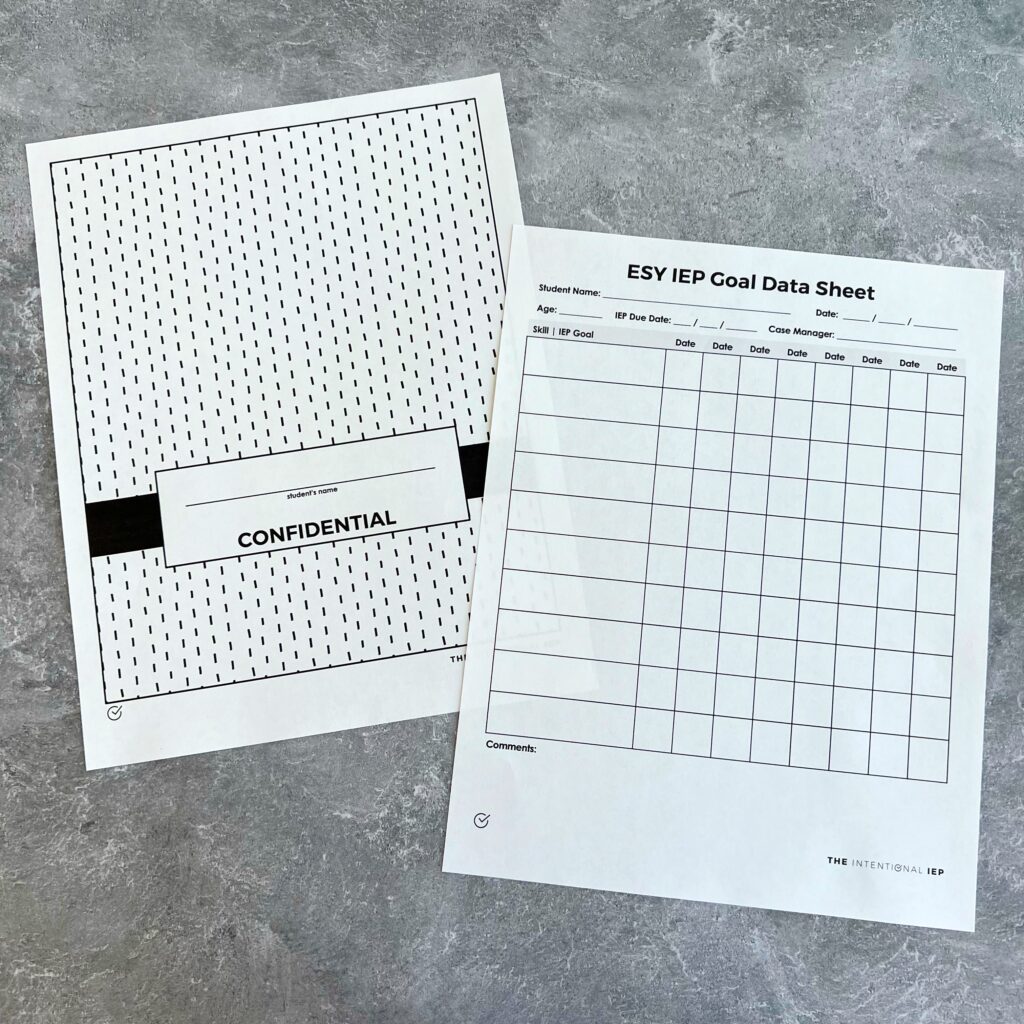
While some teachers may feel unsure of how to gather and organize this data, the good news is that it doesn’t require starting from scratch. Most of the information can be pulled from the data you’re already collecting for IEP progress monitoring, behavior plans, and related service logs. Graphs showing pre- and post-break performance, ABC behavior data comparing patterns before and after holidays, anecdotal teacher notes, and even work samples dated before and after breaks all provide evidence of regression or slowed progress. Comparing these points over time can help teams make informed decisions—and can ensure that students who truly need ESY services receive them.

That constant mental checklist? The IEPs swirling in your head? The weight you carry for every student?
You don’t have to do it all alone. The Intentional IEP gives you the support, structure, and ready-made tools to turn IEP chaos into clarity. Take a deep breath – you’ve found your solution.