
If you have ever followed a behavior plan exactly as written and still watched the same behavior happen day after day, you are not alone.
Sometimes the behavior strategy isn’t a good fit. Sometimes you can’t consistently implement the strategy in a busy classroom. But more frequently, we had written a plan around what the behavior looked like instead of what the student was getting, avoiding, communicating, or regulating through it. And that is the work of a Functional Behavior Assessment, or FBA.
An FBA should help a team understand what is happening well enough to make a better plan. It is not a form we complete so we can mark off a checkbox. Think of it like an investigation, and the quality of the behavior plan depends on how honest and thorough that investigation is.
Principle #1: The same behavior can serve very different functions
We often hear that behavior is communication, and it is, but it does not mean every behavior sends an obvious message… or that the student could explain the reasoning behind why they threw that desk, or refused to do work, or walked out of the classroom, if we asked.

As professionals, we do understand, though, that there are 4 major functions of behavior. Behavior can help a student:
- Get interaction or attention
- Delay, avoid, or escape something
- Gain access to an item, activity, or person
- Create or reduce sensory input
Those categories, or 4 areas of behavioral function, give us somewhere to start, but they are not the conclusion or final answer to our questions.
Consider two students who both rip up a worksheet. One student may have learned that ripping the paper gets an adult to sit beside them and help. Another may be escaping a writing task that feels impossible. The behavior looks the same, but using the same response for both students would miss the point.
This is also where adults can make an understandable mistake: we assign intent too quickly. We say the student is being defiant, wants control, knows better, or is trying to get out of work. Maybe the student is avoiding the task, but that still does not tell us why. Is the task too difficult? Is there too much writing? Is the student afraid of being wrong? Is the room too noisy to think? Has asking for help worked for that student before?
If you need a starting point, you can download this free resource to help analyze a behavior’s possible function.
Principle #2: Good data makes the story more specific
I have sat in IEP meetings where everyone agreed that a student “always” did something, until we looked at the data. “Always” turned out to mean during independent writing. “Out of nowhere” turned out to mean after the third correction from an adult. “All afternoon” turned out to mean the first ten minutes after lunch, especially when the class came back loudly.
That is why data matters, and why analyzing the data matters so much more. It slows down the story we have already started telling ourselves.
ABC data can help us record what happened before the behavior, what the student actually did, and what happened immediately afterward. Frequency data tells us how often something happens. Duration data tells us how long it lasts. Observing across people, places, tasks, and times helps us see whether a pattern holds up outside one classroom or one adult’s experience.
But collecting more data is not automatically better. I have seen beautiful data sheets filled with information that no one could use. If the behavior is written as “had a bad attitude,” we cannot measure it reliably. If the antecedent says only “math,” we may miss that the behavior occurred when the student was given a full page of independent word problems, not during the small-group lesson five minutes earlier.
Useful data is specific enough that another person could recognize the same event.
Instead of writing: The student became frustrated and refused to work.
Try: After receiving a worksheet with 10 written response questions, the student pushed the paper away, put their head on the desk, and did not begin the task for 8 minutes. The worksheet was removed, and the student was sent to the calm down area, where they stayed until the end of the class period.
The second version is not more useful because it sounds formal, but because it tells us what actually happened. It’s objective, and that’s how we should be writing all of our data – without opinions or emotion.
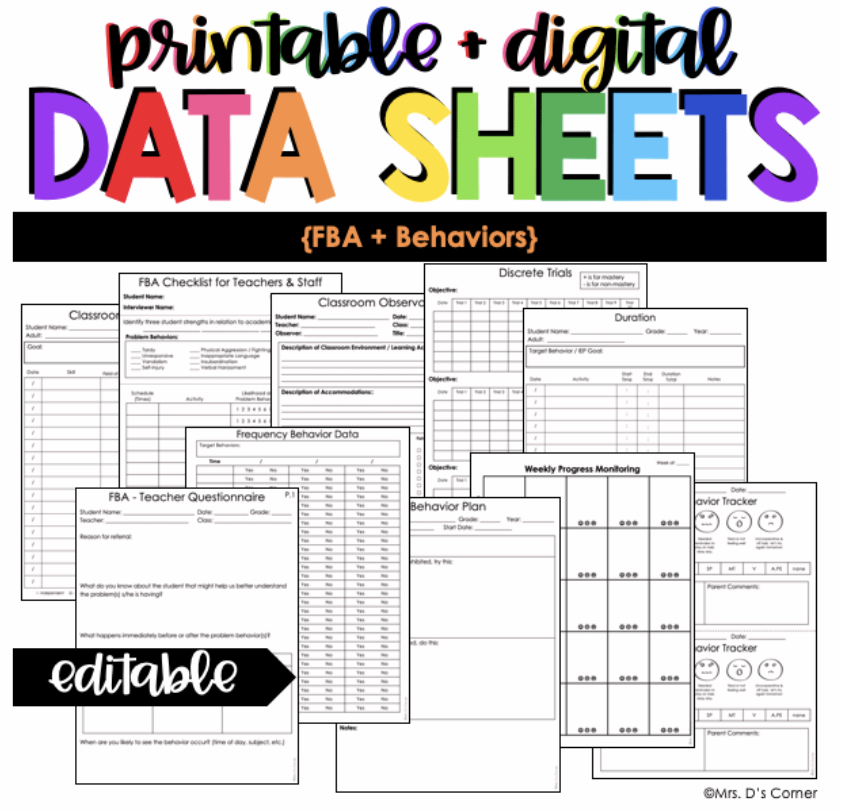
Pro Tip: staff responses are part of the data, too. If one adult prompts 3 times, another removes the task immediately, and another begins negotiating, the student is experiencing 3 different patterns. We cannot understand the behavior without looking at what the adults do around it.
Principle #3: A hypothesis should help you build the plan
The purpose of gathering all that information is to develop a reasonable hypothesis about the behavior’s function. Make a hypothesis based on what the data is going to tell you. That means looks for data about situations in which the behavior is most likely to occur, the actual behavior you can observe, and what the student appears to gain, delay, avoid, or regulate afterward.
An FBA does not give us access to a student’s private thoughts. We are using the best available evidence to explain a pattern, and we should stay willing to revise that explanation if the plan does not work or new information emerges.
For example:
When given an independent writing task with multiple open-ended responses, the student puts their head down, pushes the paper away, and does not begin. This behavior is more likely when writing demands exceed the student’s current independent skills and often results in the task being delayed or removed.
That gives us much more direction than “The student refuses work to escape demands.”
Now the team can ask practical questions. Does the student need the task broken into smaller parts? A way to request help or a short break? Explicit instruction in the writing skill? A model or sentence starter? Fewer items while the skill is being built? Reinforcement for beginning rather than only for completing the entire task?
The replacement behavior has to work for the student, not just look better to adults.
If putting their head down reliably makes a difficult task disappear, but appropriately asking for help leads to “You know how to do this. Try first,” we should not be surprised when the student keeps putting their head down. The replacement skill must be efficient, honored consistently, and taught when the student is calm enough to learn it.

We also have to address the environment. A break card cannot compensate for work that is far beyond the student’s instructional level. Teaching “coping skills” will not fix an unpredictable schedule. A reward system will not replace needed communication support.
A strong behavior plan does both: it teaches the student a more effective skill and changes the conditions that keep making the behavior necessary.
Principle #4: The people closest to the student hold different pieces of the pattern
No one person sees the student the entire school day, so you’re going to want to get multiple data points, or perspectives, on the child’s day.
For example: the classroom teacher may notice that behavior increases during writing. A related-service provider may see the student complete similar work when choices and visual supports are available. A paraeducator may know that the student starts showing smaller signs of distress several minutes before the behavior adults usually record. A family may report poor sleep, a medication change, or a similar pattern during homework. The student may be able to tell us that the room feels too loud or that they avoid asking for help because they do not want classmates to notice.
No perspectives automatically outweighs the others, there’s no weight granted here. But all of this data should help the team test the pattern. We need to compare what everyone sees, notice where accounts differ, and ultimately ask why. Sometimes the differences are the most valuable part. If the behavior happens with one task, one setting, or one adult but not another, that doesn’t mean anyone’s data is wrong either. It gives us a natural comparison and more powerful data.
Side note: It also matters who will have to implement the plan. I have seen BIPs that required a general education teacher to deliver reinforcement every two minutes in her classroom where she was responsible for twenty other students, too. What we planned may have sounded great in theory, but it was not functionally usable in that real classroom (you know, outside of the IEP meeting). If the teachers implementing the plan cannot carry it out consistently, the IEP team needs to adjust the plan.
What this should change in the classroom
A useful FBA should leave the team with more than a label for the behavior. It should help everyone understand:
- When the behavior is most and least likely to happen
- What may be making the situation harder for the student
- What the student currently accomplishes through the behavior
- What replacement skill needs to be explicitly taught
- What adults will change before, during, and after the behavior
- How the team will know whether the plan is helping
And, even then, the plan may still need revision. That does not automatically mean the FBA failed. Behavior changes, environments change, demands change, and sometimes our first hypothesis is wrong. The responsible response is to return to the data and adjust—not keep using the same plan because it is already written.
Behavior is information, but we have to be careful not to pretend it gives us a simple answer. An FBA helps us slow down, look for patterns, test what we think we know, and build support around the actual student in front of us. When we do that well, we spend less time reacting to behavior after it happens and more time teaching the student what to do instead.
That is the part that matters—not whether the paperwork looked good or we checked boxes for compliance, but whether the behavior plan makes the school day more workable for the student and the people supporting them.
Writing the IEP is only one part of managing it. The Intentional IEP System helps special education teachers manage the work before, during, and after the meeting—from baselines and goals to timelines, implementation, progress monitoring, and everything in between. Instead of piecing together another resource every time something comes up, you’ll have one educator-led system designed to help you know what to do, have what you need, and know what’s next. See how The Intentional IEP System works →